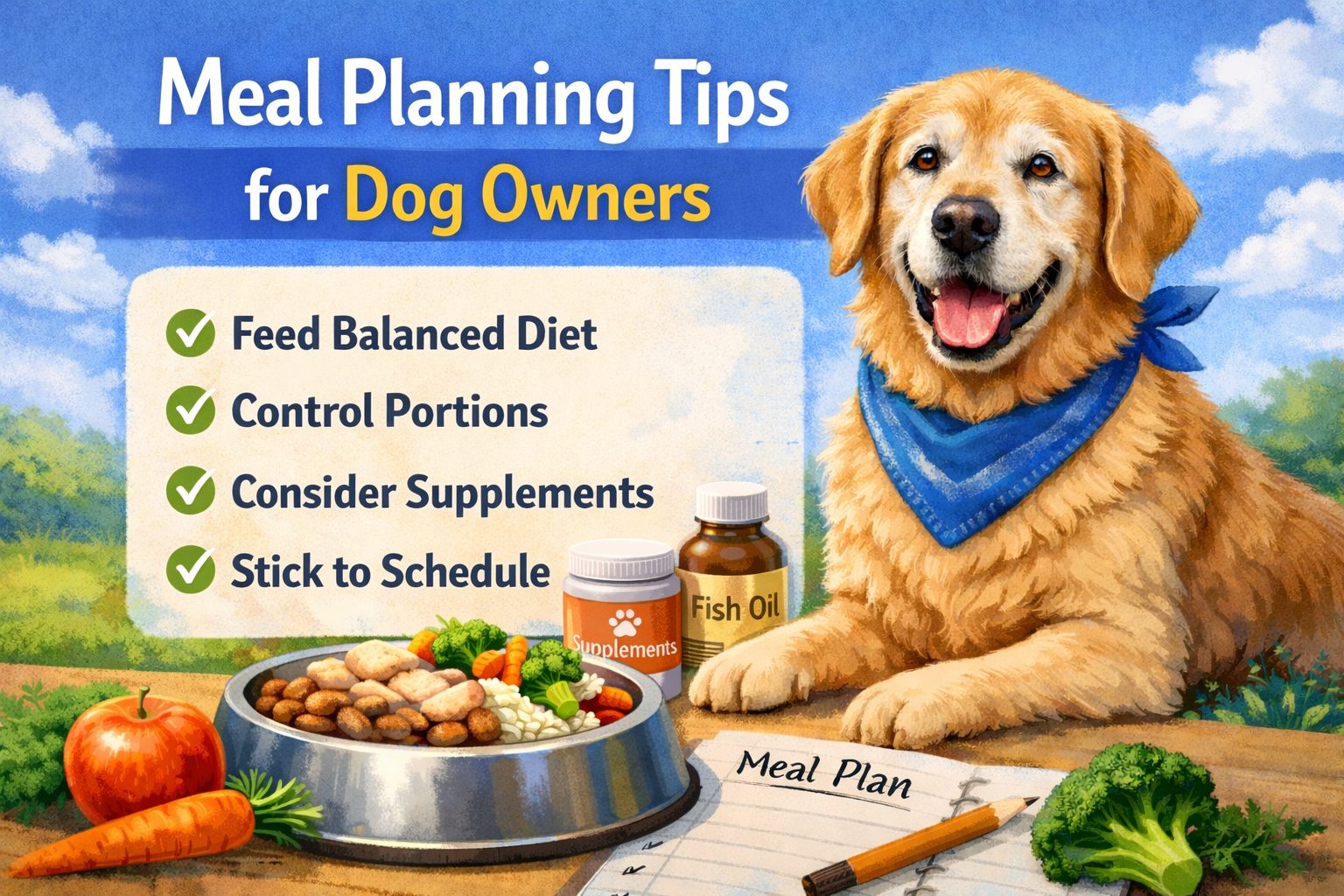
Effective meal planning for dog owners involves rotating proteins weekly, batch cooking on weekends, tracking daily calories by weight, supplementing gaps with fish oil and vitamins, and keeping a weekly feeding schedule. Consistency and variety are the two pillars of excellent canine nutrition.
Introduction: Meal Planning Is for Dog Owners Too
Humans spend billions of dollars annually planning their own meals — subscribing to meal kit services, using food tracking apps, and meal prepping on Sundays. Yet when it comes to their dogs, most owners wing it: pour kibble, top up water, repeat.
The result is often dogs that are technically fed but not optimally nourished. Meal planning for your dog does not have to be complex. With a few smart strategies, you can significantly improve what goes into your dog’s bowl every day, save money, reduce waste, and give yourself peace of mind that your companion is genuinely thriving.
Here are the most effective meal planning tips for dog owners that actually make a difference.
Tip 1: Start with a Weekly Protein Rotation
Feeding the same protein every single day limits your dog’s nutritional intake and can over time build food sensitivities. A simple 4 to 5 protein rotation — chicken, turkey, beef, fish, and eggs — covers a much wider nutritional spectrum and keeps your dog interested in mealtime.
Set up your rotation at the start of each week. Prep each protein in advance (boil chicken, brown turkey, cook salmon) and store in airtight containers in the fridge for up to four days, or freeze additional portions for the second half of the week.
Tip 2: Batch Cook on the Weekend
The single most effective time-saving habit for dog meal planning is dedicating 45 to 60 minutes on Sunday to batch cooking. In that time you can boil a full batch of chicken thighs, cook a pot of rice, steam a tray of sweet potatoes, and hard-boil a dozen eggs.
Portion everything into daily servings. Label and refrigerate. The rest of your week becomes as simple as opening a container and scooping kibble. You will be shocked how much stress this removes from daily feeding routines.
| Food Item | Prep Time | Stores In Fridge | Servings (35 lb dog) |
| Boiled chicken thighs (1 lb) | 25 min | 4 days | 5–6 servings |
| Cooked white rice (2 cups dry) | 20 min | 5 days | 8–10 servings |
| Steamed sweet potato (2 medium) | 20 min | 4 days | 6–8 servings |
| Hard-boiled eggs (6) | 12 min | 5 days | 6 servings |
| Cooked oats (2 cups dry) | 15 min | 5 days | 8–10 servings |
| Ground turkey (1 lb) | 15 min | 3–4 days | 5–6 servings |
Tip 3: Always Plan Around Your Dog’s Caloric Needs
Before planning meals, calculate how many calories your dog needs per day. This single number drives every portioning decision you make. Without it, you are guessing — and guessing tends to lead to either overfeeding or underfeeding.
Use the 30 x body weight in kg formula as a quick estimate, or consult our Portion Guide by Dog Weight for detailed breakdowns. Once you know your dog’s daily caloric target, you can portion kibble and fresh food additions precisely.
Tip 4: Use Kibble as a Base, Not the Entire Diet
A good dry kibble is a convenient and nutritionally complete foundation. But it does not have to be the whole story. Adding whole-food toppers — a spoonful of pumpkin puree, a few pieces of cooked chicken, a drizzle of fish oil — significantly improves the meal’s palatability and nutritional density without dramatically increasing cost.
Think of kibble as a reliable floor and whole foods as the ceiling. Your goal is somewhere comfortably above the floor every day.
Tip 5: Keep a Feeding Journal for the First Month
When establishing or changing a meal plan, keep a simple daily log for the first 30 days. Note what your dog ate, how much, whether they finished the meal, stool quality, energy level, and any unusual symptoms. This data is invaluable for identifying what works and what does not — and your vet will appreciate it too.
Tip 6: Plan Treats as Part of the Meal Plan
Treats are not separate from the meal plan — they are part of it. If your dog gets 800 calories per day and receives 150 calories worth of treats, that leaves only 650 calories for meals. Many dogs are subtly overfed every day simply because treats are not being counted.
Plan treats weekly just as you plan meals. Choose single-ingredient treats that are low-calorie and nutritionally meaningful, not empty fillers.
Tip 7: Invest in a Good Kitchen Scale
Especially if you feed any amount of home-cooked food, a kitchen scale is a non-negotiable tool. Volume measurements (cups, tablespoons) vary widely depending on how packed or loose the food is. Weight measurements in grams are consistent every time. A digital kitchen scale costs under 15 dollars and will last years.
Tip 8: Rotate Vegetables for Maximum Nutrient Coverage
| Vegetable | Key Nutrients | Prep for Dogs | Serving Frequency |
| Sweet Potato | Beta-carotene, fiber, Vitamin C | Boil or steam, mash | 2–3x per week |
| Carrots | Vitamin A, fiber, dental benefit (raw) | Raw or lightly steamed | Daily if desired |
| Peas | Protein, Vitamin K, fiber | Frozen or fresh, cooked | 3–4x per week |
| Pumpkin | Fiber, Vitamin A, digestive aid | Plain canned or cooked | Daily in small amounts |
| Broccoli | Vitamin C, K, fiber, calcium | Steamed, small pieces only | 2x per week (limit) |
| Green Beans | Fiber, Vitamins C & K, low cal | Raw or steamed | Daily if needed for weight |
Tip 9: Keep Emergency Supplies Stocked
Even the best meal planner sometimes runs out of fresh food mid-week. Keep pantry staples stocked at all times: a backup bag of kibble, canned plain pumpkin, a bag of rice, canned tuna in water, and a jar of coconut oil. These ingredients can cover any meal gap in minutes.
Tip 10: Reassess Every 90 Days
Your dog’s needs change over time. A dog that was 3 years old and highly active last year may now be 4 years old, slightly less active, and subtly heavier. Review your dog’s meal plan every 90 days. Check weight, assess body condition, consult vet notes, and adjust caloric targets and food choices accordingly.
Recommended Meal Planning Products
| Product | Why We Recommend It | Where to Buy |
| Etekcity Digital Kitchen Scale | Essential for accurate home-cooked portioning | Amazon.com |
| Merrick Real Chicken + Sweet Potato | Premium topper-ready kibble base, real first ingredients | Chewy.com |
| Zesty Paws 8-in-1 Multivitamin | Covers common nutritional gaps in planned fresh-food diets | Amazon.com |
Frequently Asked Questions
A: Refrigerated home-cooked food lasts 3 to 4 days safely. Freeze anything beyond that in portion-sized containers.
A: Forgetting to account for treats. Most dogs who are ‘fed correctly’ but still overweight are getting too many treat calories that are not being tracked.
A: Some work for basic calorie tracking. However, dog-specific apps like PetDesk or DogLog are better suited to tracking canine nutrition accurately.
A: Yes. Age, breed, activity level, health conditions, and size all affect what a dog should eat. A one-size-fits-all plan works only as a starting framework.
A: Introduce new ingredients gradually, warm the food slightly to enhance aroma, and add small amounts of a strong-smelling protein like salmon or tuna as a topper.
A: Raw feeding can be nutritionally excellent but requires careful planning to avoid bacterial risk and nutritional imbalances. Consult a veterinary nutritionist before switching.
Affiliate Disclosure: This article may contain affiliate links. If you purchase through these links, we may earn a small commission at no extra cost to you.
Medical Disclaimer: “This content is for informational purposes only and is not a substitute for professional veterinary advice, diagnosis, or treatment.”