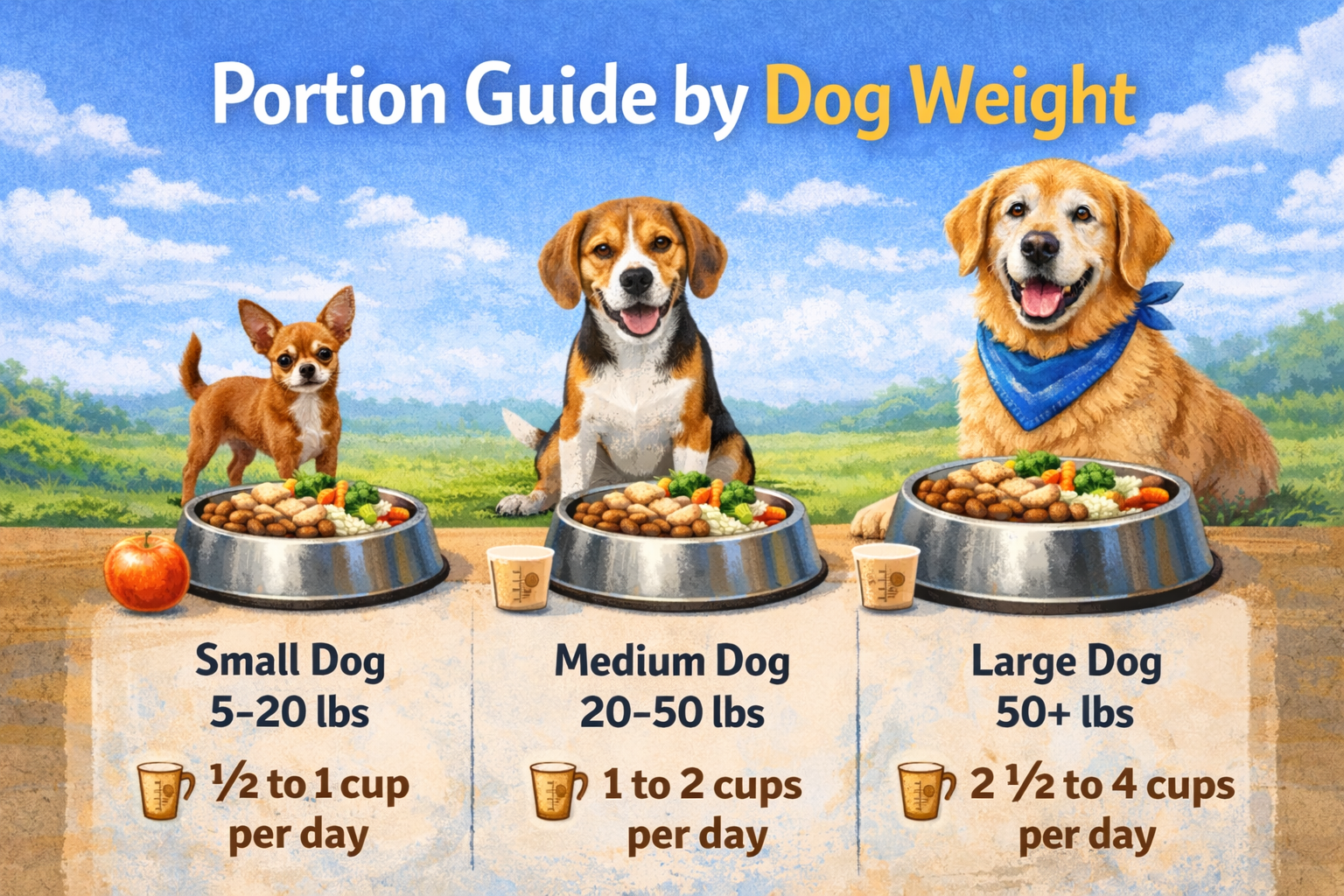
Dog food portions depend on weight, age, and activity level. A general guideline is 25 to 30 calories per pound of body weight per day for adult dogs. Small dogs (under 20 lbs) need roughly 200–400 calories, medium dogs (20–50 lbs) need 450–900 calories, and large dogs (50–100+ lbs) need 1,000–1,800 calories daily.
Introduction: Why Portion Size Matters More Than You Think
Most dog owners underestimate the importance of portion control. It is tempting to pour food until the bowl looks full or to simply follow the feeding chart on the back of the bag without considering your individual dog’s needs. But overfeeding is the leading cause of canine obesity, which affects joints, organ function, lifespan, and quality of life.
Equally, underfeeding — particularly in growing puppies, working dogs, or nursing females — can lead to dangerous nutritional deficiencies. Getting portions right is not about restriction; it is about precision.
The Calorie Formula for Dogs
The most reliable way to portion your dog’s food is to start with their Resting Energy Requirement (RER) and then multiply by an activity factor.
RER = 70 x (body weight in kg) to the power of 0.75
This gives you the baseline calories your dog needs at rest. From there, multiply by a factor based on their life stage and activity level:
| Life Stage / Activity | Multiply RER By | Example (10 kg dog RER = 394 kcal) |
| Intact adult (normal activity) | 1.8 | 709 kcal/day |
| Neutered adult (normal activity) | 1.6 | 630 kcal/day |
| Inactive/obese-prone adult | 1.2–1.4 | 473–552 kcal/day |
| Active working dog | 2.0–5.0 | 788–1,970 kcal/day |
| Puppy (under 4 months) | 3.0 | 1,182 kcal/day |
| Puppy (4–12 months) | 2.0 | 788 kcal/day |
| Senior dog (low activity) | 1.2 | 473 kcal/day |
| Pregnant or nursing | 2.0–4.0 | 788–1,576 kcal/day |
Simple Portion Guide by Dog Weight (Adult Dogs)
| Dog Weight | Daily Calories | Dry Kibble (approx) | Home-Cooked (approx) |
| 5–10 lbs (toy breeds) | 175–350 kcal | 1/4 to 1/2 cup/day | 100–200 g/day |
| 10–20 lbs (small breeds) | 350–600 kcal | 1/2 to 1 cup/day | 200–350 g/day |
| 20–30 lbs (small-medium) | 600–800 kcal | 1 to 1.5 cups/day | 350–450 g/day |
| 30–50 lbs (medium breeds) | 800–1,100 kcal | 1.5 to 2.5 cups/day | 450–600 g/day |
| 50–75 lbs (large breeds) | 1,100–1,500 kcal | 2.5 to 3.5 cups/day | 600–850 g/day |
| 75–100 lbs (large breeds) | 1,500–1,900 kcal | 3.5 to 4.5 cups/day | 850–1,100 g/day |
| 100+ lbs (giant breeds) | 1,900–2,800 kcal | 4.5 to 6 cups/day | 1,100–1,500 g/day |
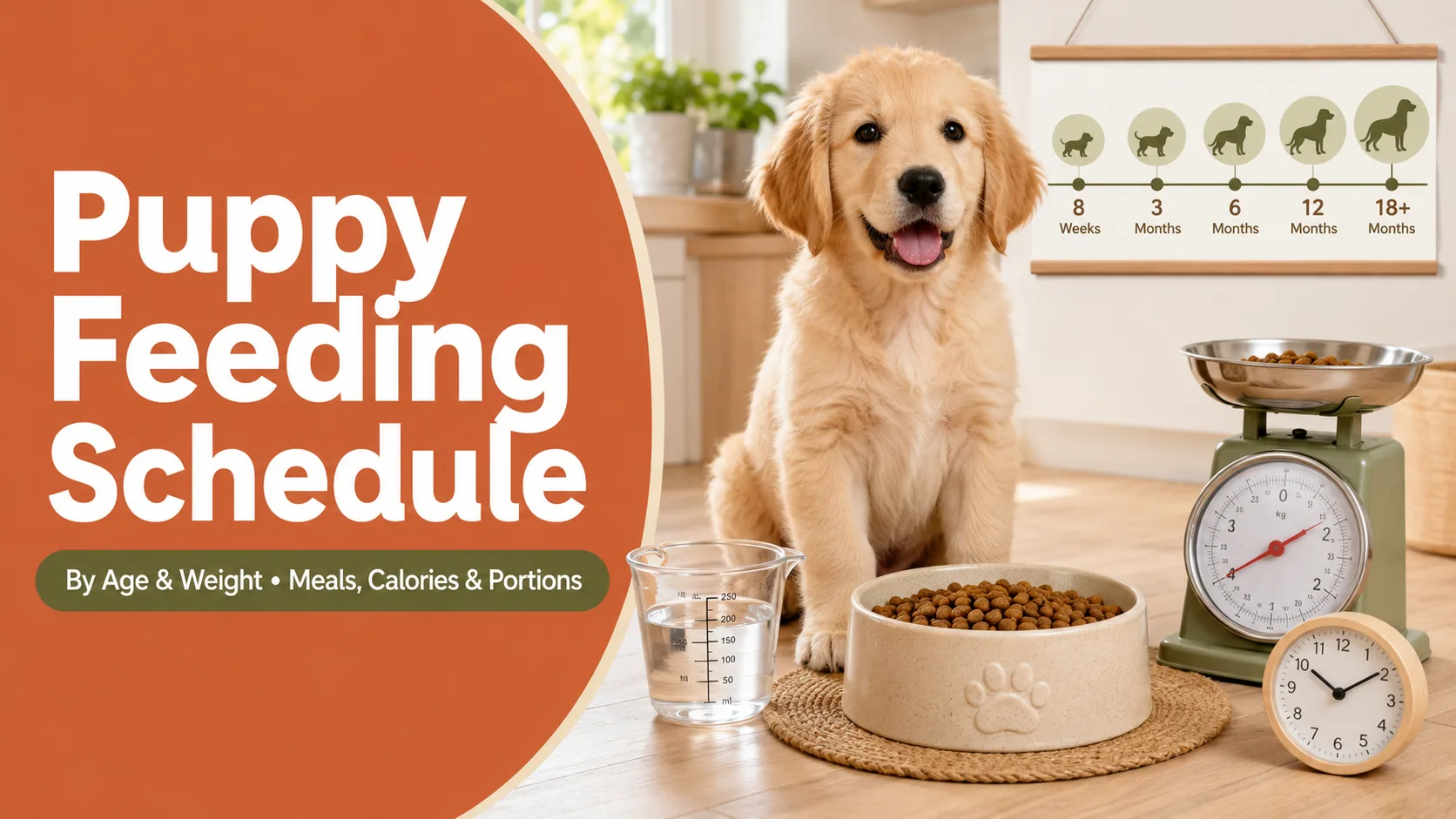
Puppy Portion Guide by Weight
| Puppy Weight | Estimated Age | Daily Calories | Meals Per Day |
| Under 5 lbs | Under 8 weeks | 130–200 kcal | 4–5 times |
| 5–10 lbs | 8–12 weeks | 200–350 kcal | 3–4 times |
| 10–20 lbs | 3–5 months | 350–550 kcal | 3 times |
| 20–40 lbs | 5–9 months | 550–950 kcal | 2–3 times |
| 40–70 lbs | 6–12 months | 950–1,500 kcal | 2–3 times |
| 70+ lbs | 9–18 months | 1,400–2,200 kcal | 2–3 times |
Senior Dog Portion Adjustments
Senior dogs — typically those over 7 years old, or over 5 for giant breeds — generally need 20 to 30 percent fewer calories than their adult peak. Their metabolic rate slows, activity decreases, and muscle mass can decline even at stable weight.
Do not simply reduce portion sizes drastically. Instead, switch to a senior-formulated food with adjusted protein and fat levels, or reduce caloric density while maintaining volume to help your dog feel satisfied.
How to Tell if Your Dog is Over or Underfed
Body Condition Score (BCS): Run your hands along your dog’s ribcage. You should be able to feel each rib easily with light pressure but not see them. If ribs are visible, your dog may be underfed. If you cannot feel them through thick fat, overfeeding is likely.
Waist Check: When viewed from above, a healthy dog should have a visible waist — a narrowing between the ribcage and hips. No visible waist suggests excess weight.
Tummy Tuck: From the side, the abdomen should tuck up slightly from the chest toward the hindquarters. A sagging or barrel-shaped belly often indicates excess weight.
Common Portioning Mistakes
- Using cup measurements without leveling — always level off the cup for consistent portions.
- Forgetting to count treats — a large biscuit can add 50 to 100 calories per piece.
- Using the bag guide as gospel — those charts assume average activity and often skew high.
- Not adjusting for weight changes — re-assess portion size every 3 to 4 months.
- Giving equal portions to multiple dogs of different sizes — each dog needs individual assessment.
Recommended Portioning Tools
| Product | Why We Recommend It | Where to Buy |
| OXO Good Grips Dog Food Scoop | Marked measuring scoop ensures consistent daily portions every time | Amazon.com |
| Etekcity Kitchen Food Scale | Precise gram measurements for home-cooked diets | Amazon.com |
| Royal Canin Size Health Nutrition | Weight-specific kibble formulas, removes portion guesswork | Chewy.com |
Frequently Asked Questions
A: Approximately 2 to 2.5 cups of standard dry kibble per day, split into two meals. Always check the calorie density of your specific brand.
A: Yes, especially for home-cooked diets or if your dog is overweight. A kitchen scale gives much more accurate results than volume cups.
A: Use the Body Condition Score method. A score of 4 to 5 out of 9 is ideal for most dogs. Your vet can assess this at annual checkups.
A: For adult dogs, once daily is not ideal. Twice daily is recommended to prevent hunger, reduce bloat risk in large breeds, and support better digestion.
A: Add low-calorie, high-fiber foods like canned pumpkin, green beans, or cucumber to bulk up meals without adding significant calories.
A: Absolutely. All treats, chews, and food toppers must be counted toward your dog’s daily caloric total.
Affiliate Disclosure: This article may contain affiliate links. If you purchase through these links, we may earn a small commission at no extra cost to you.
Medical Disclaimer: “This content is for informational purposes only and is not a substitute for professional veterinary advice, diagnosis, or treatment.”