Quick answer: Good puppy care is a sequence, not a single checklist. In the first year, establish a complete-and-balanced growth diet, veterinary and parasite-prevention plan, safe socialization, reward-based training, predictable sleep and toilet routines, grooming tolerance, and age-appropriate exercise. The pace differs by breed and health, so use this guide as a planning framework and let your veterinarian personalize the medical details.
A puppy changes quickly. The dog who needs four quiet naps and constant supervision at 9 weeks may be testing boundaries, chewing intensely, and entering adolescence a few months later. Owners often search for one perfect routine, but the useful question is: what does this puppy need at this stage?
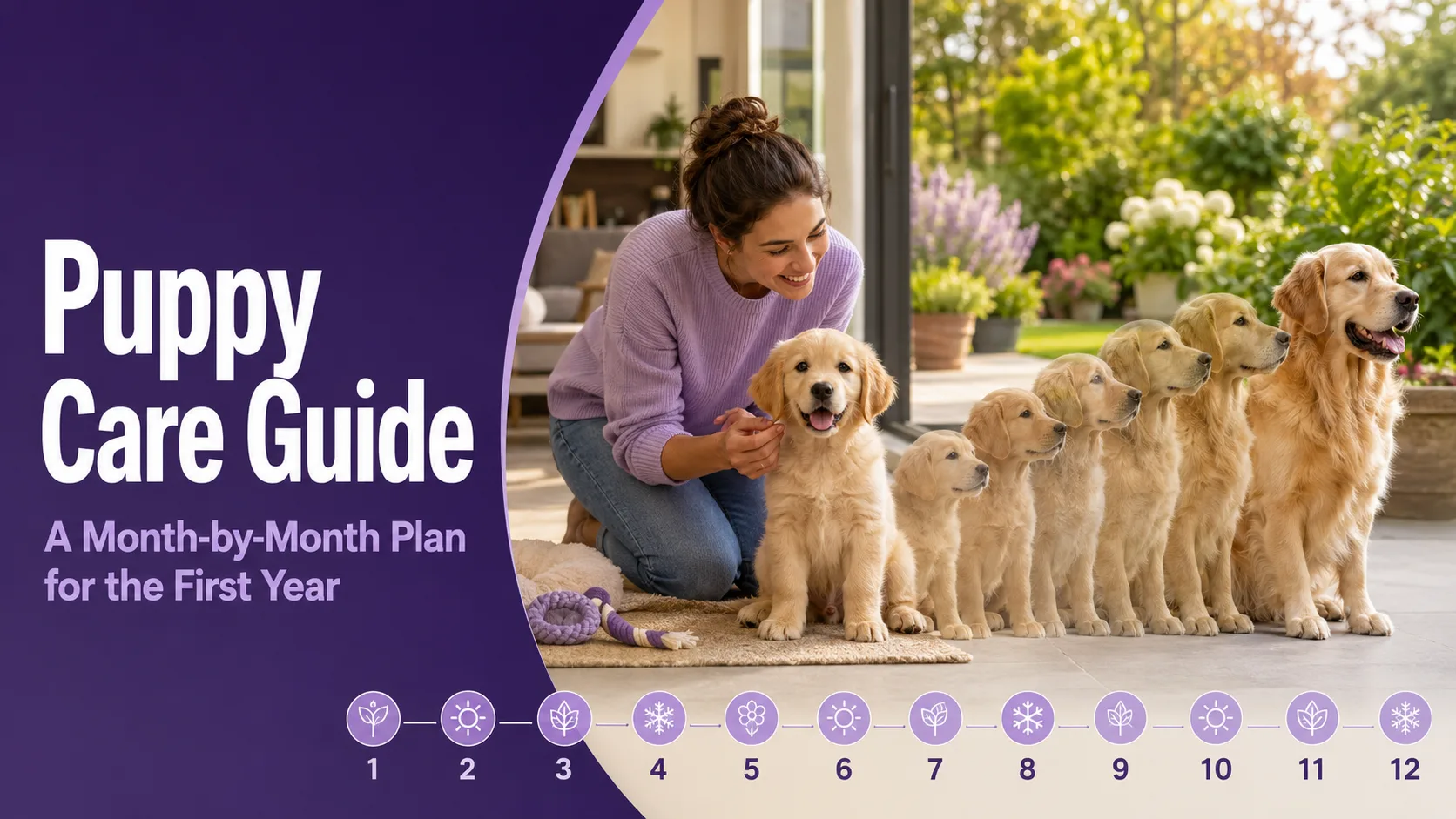
This first-year roadmap connects the decisions that owners usually research separately. It shows when feeding frequency usually changes, why vaccine timing affects where a puppy can explore, how socialization differs from forced interaction, and how training, sleep, enrichment, grooming, and preventive care reinforce one another. Use the age bands as ranges rather than deadlines.
Before Your Puppy Comes Home
Start with management. Puppy-proof one room or a gated area, secure electrical cords and medicines, remove toxic foods and plants, block stairs, and decide where the puppy will sleep and toilet. A crate or pen can be useful when introduced as a comfortable resting place—not as punishment or a way to store a puppy for long periods.
Ask the breeder or rescue for the puppy’s food, meal times, vaccine and deworming records, microchip details, recent health notes, and a familiar-smelling blanket. Book a veterinary visit soon after arrival. Keeping the first few days simple makes it easier to notice appetite, stool, urination, sleep, coughing, itching, fear, or pain that deserves attention.
- Prepare a correctly sized crate or pen, washable bedding, bowls, enzymatic cleaner, ID tag, harness, lead, and safe chew toys.
- Choose a complete-and-balanced puppy food for growth; large-breed puppies need a formula whose adequacy statement includes growth of large-size dogs.
- Agree on household cue words, toilet location, furniture rules, and who handles each meal, walk, training session, and overnight break.
- Save the regular veterinarian, nearest emergency clinic, poison-control resource, and microchip registry details in every caregiver’s phone.
The First 72 Hours: Keep the World Small
Arrival day should be calm. Offer water, show the toilet area, allow the puppy to explore one safe zone, and feed the same food on the familiar schedule. Too many visitors, rooms, dogs, toys, or outings can push a tired puppy from curiosity into fear or frantic biting.
Take the puppy outside after waking, eating, drinking, play, excitement, and before bed. Reward the finished toilet behavior immediately. Accidents are information about supervision and timing; they are not defiance. Clean quietly and adjust the schedule rather than scolding.
Puppy Care Timeline: 8 Weeks to 12 Months
| Age | Main priorities | What success looks like |
| 8–10 weeks | Bonding, vet check, food continuity, sleep, toilet trips, gentle handling | Puppy eats, rests, toilets with support, and begins to trust the home |
| 10–12 weeks | Safe socialization, name response, crate comfort, first cues | Brief positive exposures without fear or overwhelm |
| 3–4 months | Vaccine series, bite inhibition, alone-time practice, lead skills | Short calm separations and recovery after mild novelty |
| 4–6 months | Teething management, three-to-two meal transition when appropriate, recall foundations | Chews legal items and can focus briefly around distractions |
| 6–9 months | Adolescent management, impulse control, enrichment, consistent boundaries | Skills remain usable in gradually harder environments |
| 9–12 months | Adult routine transition, body-condition review, reliable life skills | Predictable routine with continued training and supervised freedom |
Feeding a Puppy for Steady Growth
Choose food by its nutritional adequacy statement, the puppy’s expected adult size, manufacturer quality controls, calorie density, and the dog’s response—not by marketing words or an ingredient list alone. The FDA explanation of complete and balanced pet food clarifies that a sole diet should be nutritionally balanced for the intended life stage.
Measure meals and track body condition. You should be able to feel the ribs under a light fat covering and see a waist from above. A cup is not a universal calorie unit: two foods can deliver very different calories per cup. Start with the product guide, divide the daily amount among meals, and adjust with your veterinarian as growth and body condition change.
- Most weaned puppies do well on three meals daily until about 6 months and two meals from 6–12 months; toy puppies may need smaller, more frequent meals.
- Use part of the measured daily food as training rewards so treats do not silently displace balanced nutrition.
- Transition foods gradually when practical and call the veterinarian for persistent diarrhea, vomiting, poor growth, or repeated skipped meals.
- Do not add calcium, vitamins, or other supplements to a complete growth diet unless the veterinarian identifies a reason.
Vaccinations and Preventive Care
Puppies receive a series because maternal antibodies can interfere with early vaccination. The AAHA canine vaccination guidelines recommend beginning core combination vaccination around 6–8 weeks and repeating at veterinarian-set intervals until the puppy is older than 16 weeks; local risk may justify a later final puppy dose. Rabies timing follows law, and other vaccines depend on geography and lifestyle.
Vaccines are only one part of preventive care. Discuss intestinal parasites, heartworm where relevant, fleas and ticks, microchipping, dental care, growth, reproductive planning, and safe exposure in your area. Keep a written record and book the next appointment before leaving the clinic.
Socialization Without Flooding
Socialization means building safe, positive or neutral associations with the world. It does not mean that a puppy must greet every person or dog. The AVSAB puppy socialization statement identifies the first three months as the most important period and supports carefully managed socialization before the puppy is fully vaccinated.
Pair low-intensity exposure with food, play, distance, and choice. If the puppy freezes, hides, refuses food, struggles to escape, repeatedly barks, or cannot recover, increase distance and lower the challenge. Avoid dog parks, unknown dogs, and heavily contaminated ground until your veterinarian explains the local disease risk.
Reward-Based Training Priorities
Training should help the puppy understand how to succeed. Reward behaviors you want, prevent rehearsal of behaviors you do not want, and change the environment when the puppy is too tired or excited to learn. Short sessions woven into meals are more effective than one long lesson.
Prioritize a name response, recall, sit, settle on a mat, drop, leave it, loose-lead walking, gentle handling, and comfort behind a gate or in a crate. The dog training basics guide explains how to add duration, distance, and distractions without making cues unreliable.
Sleep, Exercise, and Enrichment
Puppies need abundant sleep and can look hyperactive when overtired. Protect quiet naps in a low-traffic space. Exercise should favor self-paced play, sniffing, gentle exploration, and short training rather than repetitive forced running, high jumping, or long pavement marches.
Mental enrichment can be simple: scatter part of a meal, offer a stuffed rubber toy, let the puppy sniff on a safe walk, rotate toys, teach a two-minute skill, or hide kibble in a towel under supervision. Difficulty should produce curiosity, not frustration.
Teething, Chewing, and Puppy Biting
Mouthing is normal exploration and becomes more intense during teething. Keep suitable chews within reach, redirect before the puppy clamps onto skin or clothing, and use a brief pause when play becomes too rough. A puppy who repeatedly escalates may need sleep, a toilet break, or a calmer activity.
Do not hold the muzzle shut, roll the puppy, or hit. Those responses can add fear without teaching what to bite instead. Seek professional help for stiff posture, guarding, repeated hard bites, or behavior that seems disproportionate to normal play.
Grooming and Cooperative Care
Build handling tolerance in seconds, not marathon sessions. Touch an ear, feed; lift a lip, feed; hold a paw briefly, feed. Stop before the puppy struggles. This prepares the dog for nail care, brushing, dental checks, medication, and veterinary examinations.
Coat care depends on coat type, but every puppy benefits from regular skin, ear, eye, paw, and nail checks. The site’s guide to why regular dog grooming matters can support a breed-specific routine.
Adolescence: Expect Skills to Become Uneven
Adolescence often starts around 6 months, earlier in some small dogs and later in large dogs. Increased independence, interest in the environment, and temporary sensitivity are normal. Reduce freedom before problems become habits, continue rewarding familiar skills, and practice in easier locations when performance drops.
Do not interpret an adolescent lapse as spite. Ask whether the cue was trained in that context, the reward still matters, the dog is over threshold, or a physical problem is reducing comfort. Consistency means maintaining clear outcomes, not demanding more than the dog can currently do.
Red Flags That Need Professional Help
- Repeated vomiting or diarrhea, blood, swollen abdomen, breathing difficulty, collapse, severe lethargy, toxin exposure, or inability to urinate.
- Poor growth, a suddenly ravenous or absent appetite, persistent itching, coughing, lameness, pain, or a marked change in drinking or urination.
- Extreme fear, panic when alone, guarding, escalating aggression, repeated hard bites, or behavior that worsens despite careful management.
- Loss of previously learned skills together with physical symptoms; pain and illness can change behavior.
First-Year Records to Keep
- Weight and body-condition notes, food name and calories, daily amount, stool or appetite changes, and growth photos from consistent angles.
- Vaccines, parasite tests and preventives, medications, reactions, microchip, insurance, and emergency contacts.
- Training cues, reinforcers, environments practiced, fear triggers, recovery time, and successful management strategies.
- Grooming schedule, dental routine, nail length, heat cycles if applicable, and any questions for the next veterinary visit.
Frequently Asked Questions
How often should a new puppy see a veterinarian?
Arrange an initial examination soon after arrival and then follow the schedule your veterinarian sets for the vaccine series, parasite control, growth checks, and any local risks. Sick or injured puppies should be seen sooner.
How much should a puppy sleep?
Many young puppies sleep for much of the day. Individual needs vary, but frequent naps are normal. A suddenly difficult-to-wake puppy, especially with poor appetite, vomiting, diarrhea, weakness, or breathing changes, needs veterinary advice.
When can a puppy go outside?
Safe outdoor exposure can begin before the vaccine series is complete when risk is managed. Use clean private areas, carry the puppy in high-risk places, meet known healthy dogs, and ask your veterinarian which surfaces and settings are appropriate locally.
When should a puppy switch to two meals a day?
Many puppies move from three meals to two around 6 months, while toy breeds and individual dogs may need a different schedule. The food label, growth rate, body condition, and veterinarian’s advice matter more than a fixed birthday.
How long can a puppy be left alone?
Build alone time gradually from seconds and minutes while the puppy is calm. Very young puppies need frequent toilet breaks, meals, social contact, and supervision; a full workday without appropriate care is not realistic.
When should puppy training begin?
Begin on arrival with name recognition, toilet routine, calm handling, crate or pen comfort, recall games, and rewarding behaviors you want. Keep sessions brief, easy, and reward-based.
Is puppy biting normal?
Mouthing is common, especially during play and teething. Redirect to safe chews, pause rough play, and protect sleep. Seek help for stiff or fearful behavior, guarding, repeated hard bites, or injuries..
Disclaimer
Medical and behavior disclaimer: This article is for general educational purposes and cannot diagnose or treat an individual dog. A puppy’s vaccine, nutrition, medication, exercise, and behavior plan should be tailored by a licensed veterinarian who knows the dog’s age, health, breed, environment, and local disease risks. Seek prompt veterinary care for breathing difficulty, collapse, repeated vomiting or diarrhea, marked lethargy, pain, a swollen abdomen, toxin exposure, a sudden behavior change, or any symptom that concerns you. For fear, aggression, or persistent training problems, ask your veterinarian for a referral to a qualified, reward-based behavior professional.