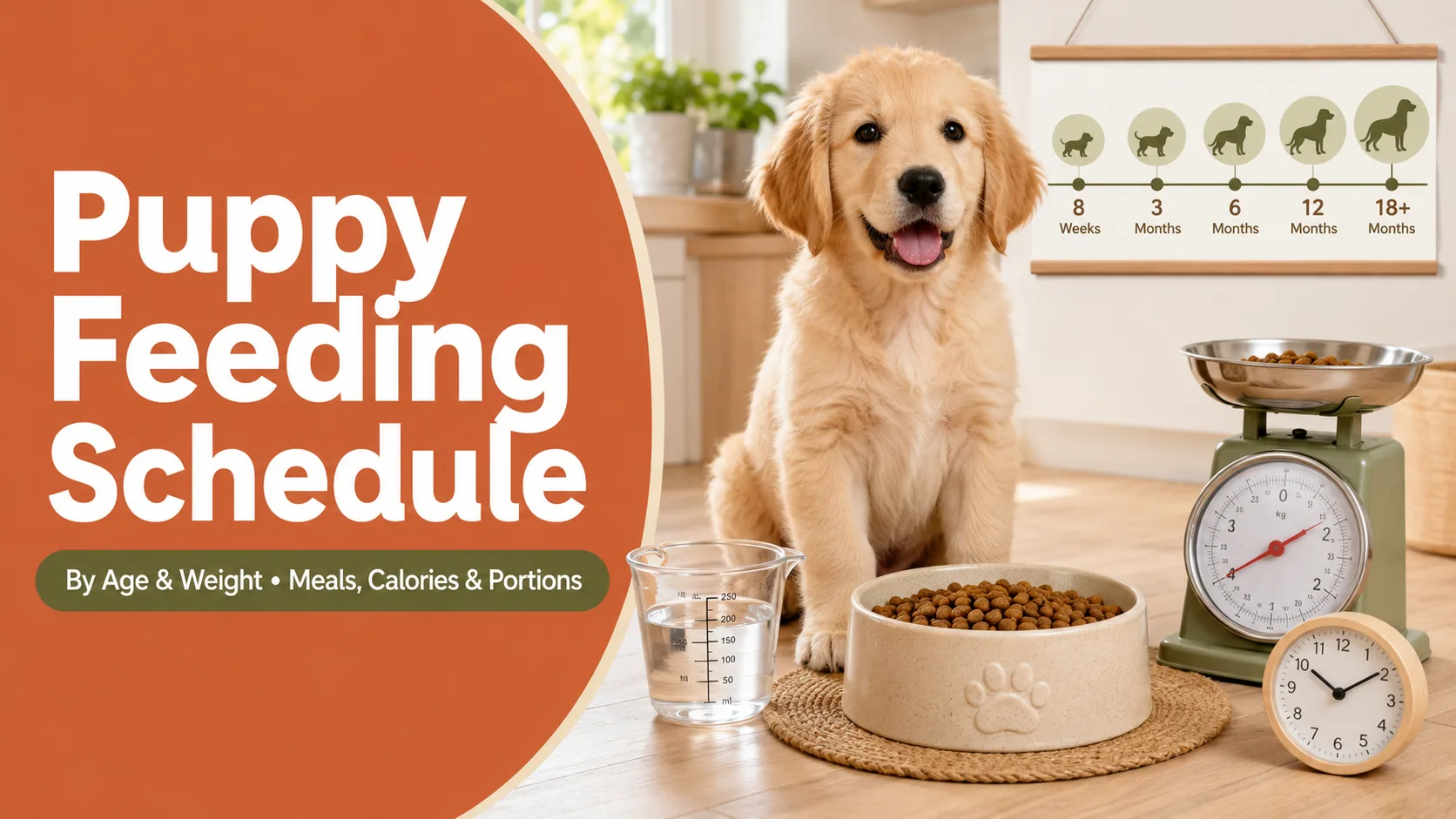
Quick answer: Most weaned puppies are fed three meals daily until about 6 months and two meals daily from 6–12 months; some toy puppies need four smaller meals early on. Portion size cannot be determined from weight alone. Start with a complete-and-balanced growth food’s guide for age and expected adult size, convert the daily calorie target using the product’s kcal per cup or can, then adjust to keep an ideal body condition.
A useful puppy feeding schedule answers two separate questions: when should meals happen, and how much energy should the puppy receive across the day? Meal frequency is fairly predictable by age. Quantity is more individual because breed size, growth stage, body condition, activity, neuter status, health, and the food’s calorie density all change the answer.
That is why a chart that assigns one cup amount to every 20-pound puppy can mislead. This guide gives a safe starting process, a worked calorie example, and weight-based planning ranges while keeping the food label and body-condition trend in control.
Puppy Feeding Frequency by Age
The Merck Veterinary Manual gives a general pattern of three meals from weaning to 6 months and two meals from 6–12 months. Very small puppies may need more frequent meals, and medical conditions can change the schedule.
Place the last meal early enough to allow a calm toilet trip before bed, but do not restrict water routinely without veterinary direction. Fresh water should be available; sudden excessive drinking or difficulty keeping water down deserves veterinary advice.
| Age | Typical meals/day | Practical rhythm |
| 8–12 weeks | 3–4 | Breakfast, midday, late afternoon, and optional early evening for small or toy puppies |
| 3–6 months | 3 | Breakfast, midday, and early evening at consistent times |
| 6–12 months | 2 | Measured breakfast and evening meal |
| 12–24 months | Usually 2 | Adult schedule when the veterinarian confirms growth is sufficiently complete |
Choose the Right Growth Food First
Look for a nutritional adequacy statement showing the food is complete and balanced for growth or all life stages. For a puppy expected to reach 70 pounds (32 kg) or more as an adult, the statement should specifically include growth of large-size dogs. This confirms that the mineral profile is appropriate for controlled skeletal development.
Do not judge quality by whether the first ingredient sounds appealing. The WSAVA food-selection guide encourages questions about formulation expertise, quality control, nutrient analysis, research, and contact transparency. Avoid adding calcium to a complete growth food unless prescribed.
How to Calculate a Starting Portion
Example: if the starting target is 900 kcal/day and the food supplies 400 kcal/cup, the arithmetic starting point is 2.25 cups per day. Across three meals, that is 0.75 cup per meal. This is not a prescription; it shows why calorie density matters. A food containing 300 kcal/cup would require a different cup volume for the same energy target.
- Find the feeding table for your puppy’s current age and expected adult weight—not just current weight.
- Find the food’s calorie density, usually listed as kcal per cup, can, tray, or kilogram.
- Use the manufacturer’s daily amount as the starting total, then divide it evenly among the day’s meals.
- Subtract calories used as training treats and toppers; most rewards can come from the measured daily ration.
- Recheck weight and body condition every one to two weeks during rapid growth and adjust gradually with veterinary input.
Weight-Based Planning Chart
Use this table to organize decisions, not to replace the product guide. Puppies of the same current weight can have different needs if one is a nearly grown small dog and the other is a young large-breed puppy. Expected adult size and body condition are essential context.
| Current weight | What to verify | Common error to avoid |
| Under 10 lb / 4.5 kg | Toy/small-breed formula, meal frequency, signs of low blood sugar | Large gaps between meals or oversized hard treats |
| 10–25 lb / 4.5–11 kg | Age column, expected adult weight, kcal per cup | Using a generic one-cup rule |
| 25–50 lb / 11–23 kg | Growth rate and waist/rib checks every 1–2 weeks | Feeding for maximum growth rather than lean growth |
| 50–70 lb / 23–32 kg | Whether adult size will exceed 70 lb; large-breed adequacy statement | Adding calcium or high-calorie toppers |
| Over 70 lb / 32 kg | Veterinary growth plan and large/giant-breed food | Switching to adult food solely because the puppy looks large |
Body Condition Is the Adjustment Dial
The number on the scale does not reveal body fat by itself. Use the WSAVA body condition chart to assess ribs, waist, and abdominal tuck. In a puppy at ideal condition, ribs are easy to feel under a light covering and a waist is visible. Breed shape and coat can make visual checks difficult, so use your hands and ask the veterinary team to demonstrate.
If the puppy is becoming rounder and the ribs are difficult to feel, do not crash-diet. Confirm that everyone is counting treats, review the daily calories, and make a measured adjustment. If the puppy is thin, failing to grow, ravenous with diarrhea, or losing weight, seek veterinary care rather than simply adding food.
Small, Large, and Giant Breed Differences
Toy puppies have small stomachs and limited energy reserves, so they may need frequent meals and prompt attention if they become weak, trembly, disoriented, unusually sleepy, or unwilling to eat. Do not try to manage those signs with internet advice; contact a veterinarian urgently.
Large and giant puppies should grow steadily and stay lean. Excess calories and unnecessary mineral supplementation can be harmful. Use a suitable large-breed growth food and resist the idea that bigger, faster growth is better.
Sample Schedule for a 12-Week-Old Puppy
Adjust times to the household, but keep intervals realistic for the puppy. The schedule should fit the toilet plan in the site’s potty training guide. A caregiver may be needed for a young puppy when the household is away.
| Time | Activity | Reason |
| 7:00 a.m. | Toilet, measured breakfast, toilet again | Builds predictable elimination routine |
| 11:30 a.m. | Measured lunch, short training, toilet | Uses meal calories for learning |
| 4:30 p.m. | Measured dinner, calm play, toilet | Avoids a very late full meal |
| 8:30–10:00 p.m. | Quiet enrichment and final toilet trips | Supports settling without overarousal |
Treats, Toppers, and Enrichment Feeding
Reserve part of each meal for recall games, handling practice, and puzzle feeders. This preserves the balanced diet while creating many reinforcement opportunities. Rich treats should be tiny, and novel foods should be introduced carefully.
Check every food-stuffed toy for calorie contribution and ingredient safety. Peanut butter must be xylitol-free, and dairy may upset some dogs. The site’s guides to peanut butter safety and yogurt for dogs can support safe choices.
When to Change the Schedule or Food
- The puppy regularly leaves a meal but remains healthy: review total calories and meal spacing rather than coaxing with endless toppers.
- Stool stays loose after a transition: stop adding new extras and contact the veterinarian if it persists or the puppy seems ill.
- Growth or body condition trends away from the veterinarian’s target: adjust measured calories, not just cup volume.
- The puppy nears adult size: ask when to transition; small breeds often mature earlier than large and giant breeds.
- A medical diagnosis, neuter, activity change, or medication changes energy needs: request an updated plan.
Common Puppy Feeding Mistakes
- Free-feeding, which hides appetite changes and makes calorie control and toilet timing harder.
- Measuring with an unmarked scoop or mug; use a standardized cup or, for precision, a kitchen scale.
- Changing food and adding several treats at the same time, making digestive reactions difficult to identify.
- Assuming grain-free, raw, boutique, or homemade automatically means healthier; nutritional adequacy and safety still have to be demonstrated.
- Adding calcium, vitamins, fish oil, or growth supplements without reviewing the complete diet with a veterinarian.
Frequently Asked Questions
How many times a day should an 8-week-old puppy eat?
Most 8-week-old puppies eat three or four measured meals. Toy puppies may need the more frequent end of the range. Confirm the schedule and daily total with the food label and veterinarian.
How many cups should I feed my puppy?
There is no safe universal cup amount. Find the product’s age-and-expected-adult-weight guide and kcal per cup, then adjust by body condition and growth. Different foods contain different calories per cup.
Can puppies eat adult dog food?
A growing puppy needs a diet complete and balanced for growth or all life stages. An adult-maintenance diet may not meet growth needs. Large-breed puppies need the appropriate large-size growth statement.
When should a puppy stop eating three meals a day?
Many puppies transition to two meals around 6 months. Toy breeds, medical conditions, appetite, and household routine may justify a different plan.
Should I wake a puppy to eat?
A healthy weaned puppy usually follows scheduled daytime meals. Very young, toy, underweight, ill, or recovering puppies may need a veterinarian-designed plan. Weakness, tremors, disorientation, or unusual sleepiness is urgent.
Is a chubby puppy healthy?
Excess body fat adds stress to developing joints and can hide rapid growth. Aim for the body condition your veterinary team recommends rather than a rounded appearance.
When should a puppy switch to adult food?
Timing depends on size and growth. Small dogs often mature earlier, while large and giant dogs may remain on growth food longer. Ask at growth checks rather than switching on a fixed date.
Disclaimer
Medical and behavior disclaimer: This article is for general educational purposes and cannot diagnose or treat an individual dog. A puppy’s vaccine, nutrition, medication, exercise, and behavior plan should be tailored by a licensed veterinarian who knows the dog’s age, health, breed, environment, and local disease risks. Seek prompt veterinary care for breathing difficulty, collapse, repeated vomiting or diarrhea, marked lethargy, pain, a swollen abdomen, toxin exposure, a sudden behavior change, or any symptom that concerns you. For fear, aggression, or persistent training problems, ask your veterinarian for a referral to a qualified, reward-based behavior professional.