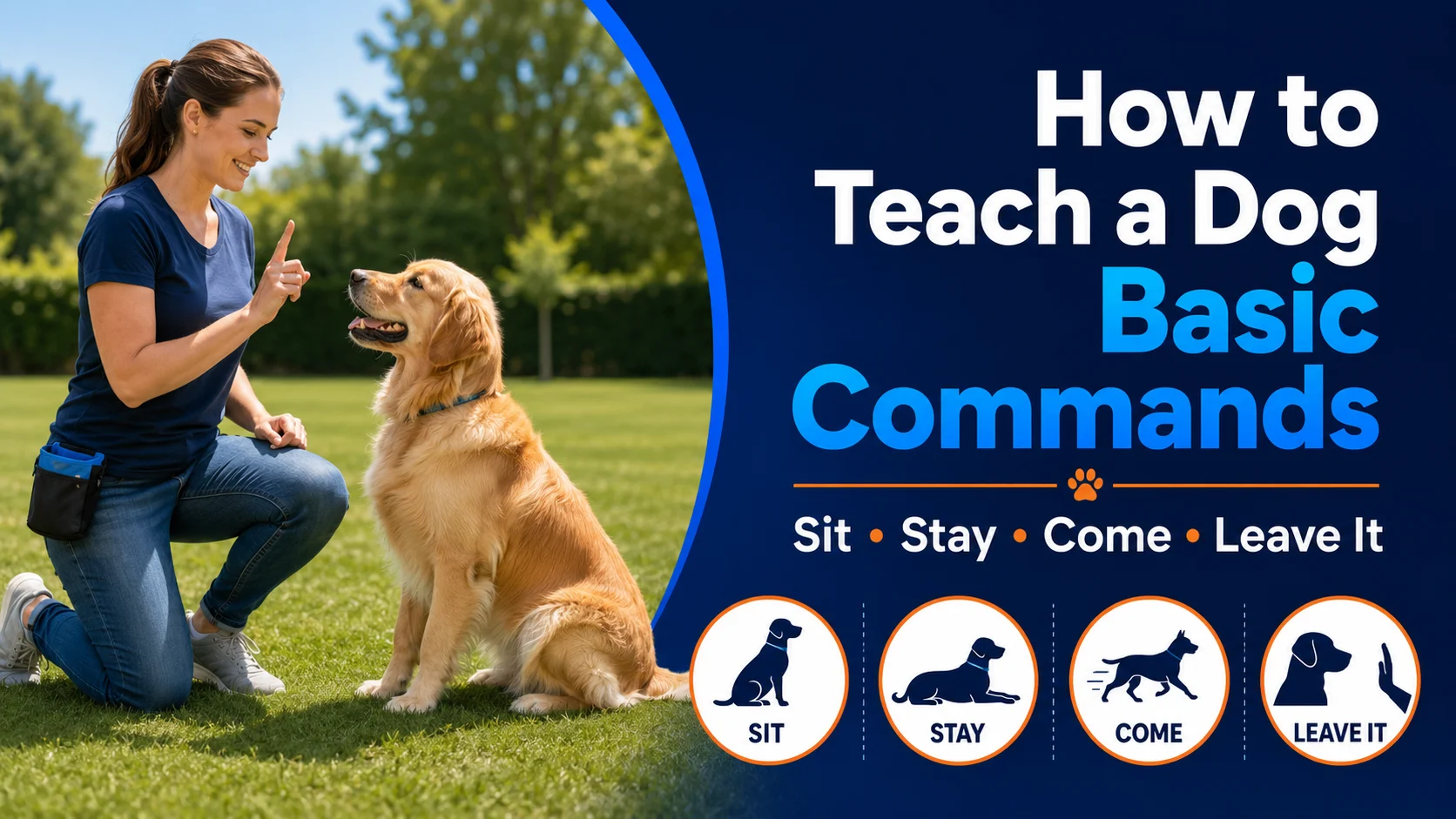
Quick answer: Teach one behavior at a time in a quiet place. First produce the behavior with a lure, capture, or shaping; mark the exact correct moment; reward; and repeat. Add the verbal cue only when the action is predictable. Then practice in new places while increasing duration, distance, and distraction separately.
Basic cues are not party tricks. Recall can interrupt danger, leave it can prevent ingestion, drop can reduce conflict, and a mat can help a dog settle during visitors or meals. Their reliability comes from carefully planned reinforcement—not louder repetition.
Use tiny rewards, a marker word or clicker, and a release cue such as ‘free.’ Keep sessions short and stop if the dog shows fear, frustration, pain, or loss of engagement.
Before You Start
- Choose a quiet, non-slip space and remove unnecessary distractions.
- Prepare pea-sized food rewards or part of the measured meal.
- Choose one marker—’yes’ or a click—and one release cue.
- Train for one to three minutes, then take a break.
- Say each cue once and change the setup after an error.
Teach Sit
Do not push the dog’s hips down. If sitting is slow, crooked, avoided, or suddenly difficult, consider the floor and physical comfort. Pain can make a simple cue unpleasant.
- With the dog standing, hold a treat near the nose.
- Move it slowly up and slightly back; as the head follows, the rear often lowers.
- Mark the instant the rear touches the floor and deliver the treat.
- Repeat until the motion is predictable, then say ‘sit’ just before the hand movement.
- Fade the food lure into a small hand signal and reward from the other hand.
Teach Down
Do not pull the front legs or press the shoulders. Some dogs feel vulnerable lying down near people or dogs; teach in a safe space and accept a different station behavior when needed.
- Start from standing or sitting on a non-slip surface.
- Move a treat from the nose toward the floor and then slightly forward.
- Mark when elbows touch the floor and reward low between the paws.
- After several easy repetitions, add ‘down’ before the hand signal.
- Use a release cue so the dog understands when the behavior ends.
Teach Stay
Stay is duration plus a release cue. Begin with the dog in a comfortable position, say ‘stay’ once, pause for one second, mark, reward in position, and release. Repeat before increasing to two seconds.
Add distance only after short duration is easy. Take half a step away and return before marking. Later add mild distractions at close distance. Do not walk away for a long period on the first day.
| Stage | Example criterion | If the dog moves |
| Duration | 1–5 seconds with handler still | Shorten the pause |
| Distance | Half-step away, return, reward | Reduce distance |
| Distraction | Small hand movement or quiet sound | Lower intensity |
| Generalization | New room with easy duration | Re-teach as a new context |
Teach Come When Called
Never call the dog for punishment or end every enjoyable activity after recall. If you are unsure, use the long line and go to the dog rather than repeating the cue.
- Indoors, say the recall cue once in a cheerful tone and move away.
- Mark as the dog commits to coming, then reward generously at your body.
- Touch the collar gently, reward again, and release the dog back to safe activity.
- Practice between two people, then in a fenced area or on a long line.
- Increase distraction by adding distance from the trigger, not by testing the dog beside it.
Teach Leave It
- Place low-value food in a closed fist. Let the dog investigate without speaking.
- The instant the dog moves away, mark and reward from the other hand.
- Repeat until the dog backs off promptly, then add ‘leave it’ before presenting the fist.
- Progress to food under a covered foot, then visible food at a safe distance.
- Reward with a different item; do not give the item the dog was asked to leave.
Teach Drop
If the dog stiffens, freezes, growls, gulps items, or guards, stop practicing trades on your own and seek professional guidance. Resource guarding is a safety issue, not disobedience.
- Begin with a low-value toy the dog likes but does not guard.
- Offer a higher-value treat at the nose and say ‘drop’ once.
- Mark the release, feed, and return the toy when safe.
- After repetitions, pause briefly after the cue before presenting the treat.
- Practice with several safe objects; never pry the mouth open or chase.
Teach Place or Mat
- Place a mat down and mark any glance or step toward it.
- Reward on the mat so position has value.
- Shape four paws, then a sit or down, without forcing.
- Add the cue when the dog is moving to the mat predictably.
- Build relaxation and duration before adding visitors, meals, or distance.
Seven-Day Practice Plan
| Day | Focus | Repetitions |
| 1 | Marker, sit, name response | 3 sets of 3–5 |
| 2 | Down and release cue | 3 short sets |
| 3 | Recall between rooms | 5 high-value recalls |
| 4 | Leave it with closed fist | 3–5 easy wins |
| 5 | Drop with low-value toy | 3 safe trades |
| 6 | Mat behavior | Several captured choices |
| 7 | Review in a second quiet location | Lower criteria in the new context |
Troubleshooting
- Dog only works when food is visible: reward from a different hand or pocket and fade the lure sooner.
- Dog does not respond to the word: the cue was added before the behavior was predictable or has been repeated too often.
- Dog leaves stay: lower duration, distance, or distraction and reward in position.
- Recall fails outdoors: use a long line, increase distance from distractions, and raise reward value.
- Dog becomes slow or avoids a position: check surface, fatigue, stress, and pain with a veterinarian.
Frequently Asked Questions
What are the most important dog commands?
Recall, leave it, drop, wait or stay, a station behavior, and loose-lead skills directly support safety. Sit and down are useful positions but not the whole foundation.
How many commands can I teach at once?
Work on a small set in brief sessions, but keep the criteria distinct. If cues or behaviors blur together, simplify and teach one at a time.
When should I say the command?
Add the cue when the dog is predictably offering the behavior after your setup. Saying a word before the dog understands it can make the cue meaningless.
Why does my dog ignore repeated commands?
Repeated cues often teach that only the last repetition matters. Say it once when success is likely, then lower difficulty or help with the trained hand signal.
Can I train without a clicker?
Yes. A short consistent marker word can work. The value comes from precise timing and a reliable reward after the marker.
How do I stop using food lures?
Fade the lure into an empty-hand signal after the motion is understood. Reward from the other hand, a pocket, or a container.
What if my dog growls during drop practice?
Stop taking items and prevent access to dangerous objects. Growling warns of discomfort. Seek guidance from a veterinarian and qualified reward-based behavior professional.
Disclaimer
Medical and behavior disclaimer: This article provides general education, not an individualized behavior diagnosis or treatment plan. Pain, illness, fear, and anxiety can change behavior, so contact a veterinarian when a behavior is sudden, severe, escalating, or accompanied by physical symptoms. Do not use intimidation, physical corrections, shock, prong, or choke-based methods. If a dog has bitten, threatens to bite, guards resources, panics, or cannot be safely managed, work with a veterinarian and a credentialed reward-based behavior professional.