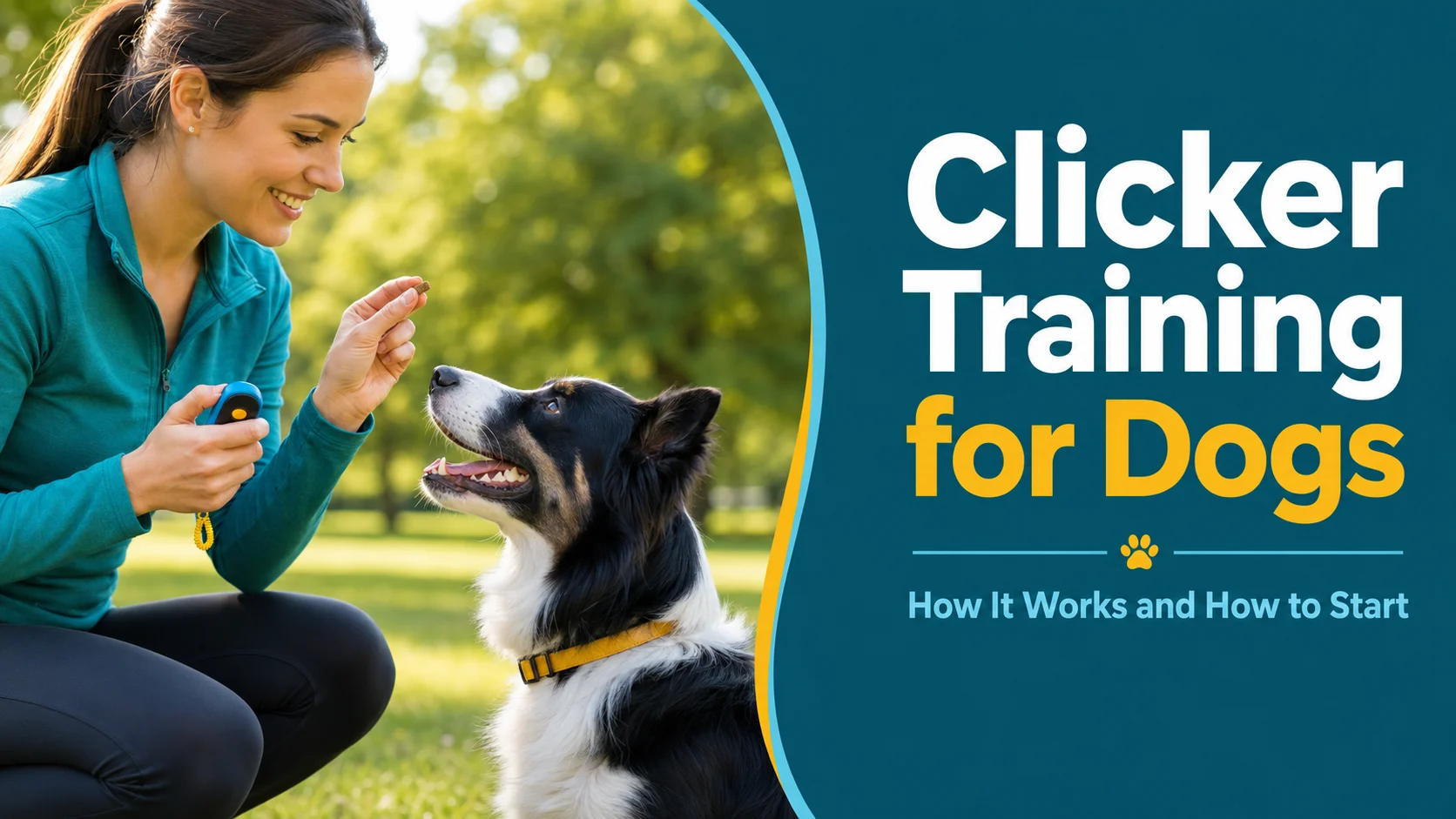
Quick answer: A clicker is an event marker: it tells the dog exactly which behavior earned reinforcement. First pair one click with one reward until the sound predicts good outcomes. Then click once at the instant the target behavior occurs and deliver the reward. The click is not a command, attention signal, or replacement for reinforcement.
The clicker is useful because it is brief, consistent, and precise. It can mark a paw touching a mat from across the room more accurately than moving food toward the dog. That precision helps the learner test and repeat behavior.
A marker word can also work. The essential system is mark, then reinforce. Choose the tool the dog can perceive comfortably and the handler can operate reliably.
What the Click Means
The click becomes a conditioned reinforcer through pairing with things the dog values. It also bridges the short gap between behavior and reward delivery. According to AVSAB’s mark-and-reward introduction, the marker provides information about the behavior the trainer wants to see more often.
Because the click identifies behavior, timing matters. Click as the rear touches the floor for sit—not while reaching for food several seconds later.
Charge the Clicker
If the sound startles the dog, soften it in a pocket, use a quieter clicker, or switch to a verbal or visual marker. The learner’s comfort matters more than the device.
- Choose a quiet room and prepare 10–15 tiny rewards.
- Click once, then deliver one reward within about a second.
- Repeat at irregular intervals without asking for behavior.
- Pause after several pairings and observe whether the dog orients after the click.
- End the session and repeat later; do not click repeatedly to test the dog without paying.
First Exercise: Capture Eye Contact
- Stand or sit quietly with rewards ready but hidden.
- When the dog voluntarily glances toward your face, click.
- Deliver the reward, then wait for another offered glance.
- After several repetitions, move to a different position.
- Add a cue only when the dog is predictably checking in.
Second Exercise: Shape a Mat Behavior
Place a mat down and wait. Click a glance toward it, then a step, then two paws, four paws, and finally lying down. Each step is a criterion. If the dog stops offering behavior, the jumps between criteria are probably too large or rewards are being delivered away from the useful position.
Shaping is not withholding help until the dog is frustrated. The trainer adjusts the environment and splits the goal into achievable pieces.
Capturing, Luring, and Shaping
| Method | How it works | Example |
| Capturing | Mark a behavior the dog offers naturally | Click a voluntary down |
| Luring | Guide movement with food, then fade the lure | Treat arc for sit |
| Shaping | Reinforce successive approximations | Steps toward a mat |
How to Add a Cue
When the behavior is occurring predictably after the setup, say the cue just before the dog begins. Mark and reward. After several repetitions, vary the setup and test the cue once.
Do not use the new cue as a prompt through dozens of failures. If the behavior does not happen, return to the previous successful setup and rebuild the association.
How to Fade the Clicker
The clicker is most useful while teaching or refining. Once a cue is fluent in a context, mark fewer easy repetitions while continuing to reinforce often enough to maintain behavior. Use praise, food, play, sniffing, and access as appropriate.
Do not abruptly remove reinforcement when the dog finally understands. Behavior weakens when its outcomes disappear, especially in difficult environments.
Clicker Timing Errors
| Error | What the dog may learn | Fix |
| Clicking late | A movement after the target is marked | Video a session and shorten the task |
| Multiple clicks | Marker loses precision | One click for one event |
| No reward after click | Marker loses predictive value | Always pay the marked repetition |
| Clicking to call dog | Click becomes an attention cue | Use the recall cue, then mark arrival |
| Holding clicker visibly as a prompt | Dog works only when tool appears | Keep hands neutral and vary setup |
Five Useful Clicker Projects
- Chin rest for cooperative handling and veterinary care.
- Nose target to guide position without pulling the collar.
- Four paws on a mat for visitors and meals.
- Voluntary entry into a travel crate or carrier.
- Quiet check-ins during loose-lead walking.
When a Clicker Is Not the Best Marker
A sound-sensitive dog may prefer a soft word or hand signal. Deaf dogs can use a visual marker or gentle vibration cue that has been positively conditioned and is not startling. In multi-dog training, each dog may need a distinct marker or separate session.
The method should adapt to the learner. Clicker training is not a reason to ignore fear, pain, fatigue, or a reward the dog no longer wants.
Frequently Asked Questions
Does a click always need a treat?
The click should reliably be followed by reinforcement. Food is common but not the only option. Do not click and then decide the repetition was not good enough.
Can the clicker be used to stop bad behavior?
Use it to mark behavior you want. For unwanted behavior, change the setup, prevent rehearsal, and teach an alternative.
What if my dog is afraid of the click?
Muffle it, use a quieter device, or switch to a word or visual marker. Never force exposure to the sound.
Can I click more than once for an excellent behavior?
One precise click communicates more clearly. Give a larger or longer reward after that single marker.
When should I add the verbal cue?
Add it when the behavior is happening predictably after the setup. Say the cue just before the action, then mark and reward.
Do I need to carry a clicker forever?
No. It is a teaching tool. Fade it as behavior becomes fluent, while maintaining meaningful reinforcement.
Can children use a clicker?
With adult supervision and a simple plan. The adult should manage food, timing, dog comfort, and safety so the child does not repeatedly click or overwhelm the dog.
Disclaimer
Medical and behavior disclaimer: This article provides general education, not an individualized behavior diagnosis or treatment plan. Pain, illness, fear, and anxiety can change behavior, so contact a veterinarian when a behavior is sudden, severe, escalating, or accompanied by physical symptoms. Do not use intimidation, physical corrections, shock, prong, or choke-based methods. If a dog has bitten, threatens to bite, guards resources, panics, or cannot be safely managed, work with a veterinarian and a credentialed reward-based behavior professional.