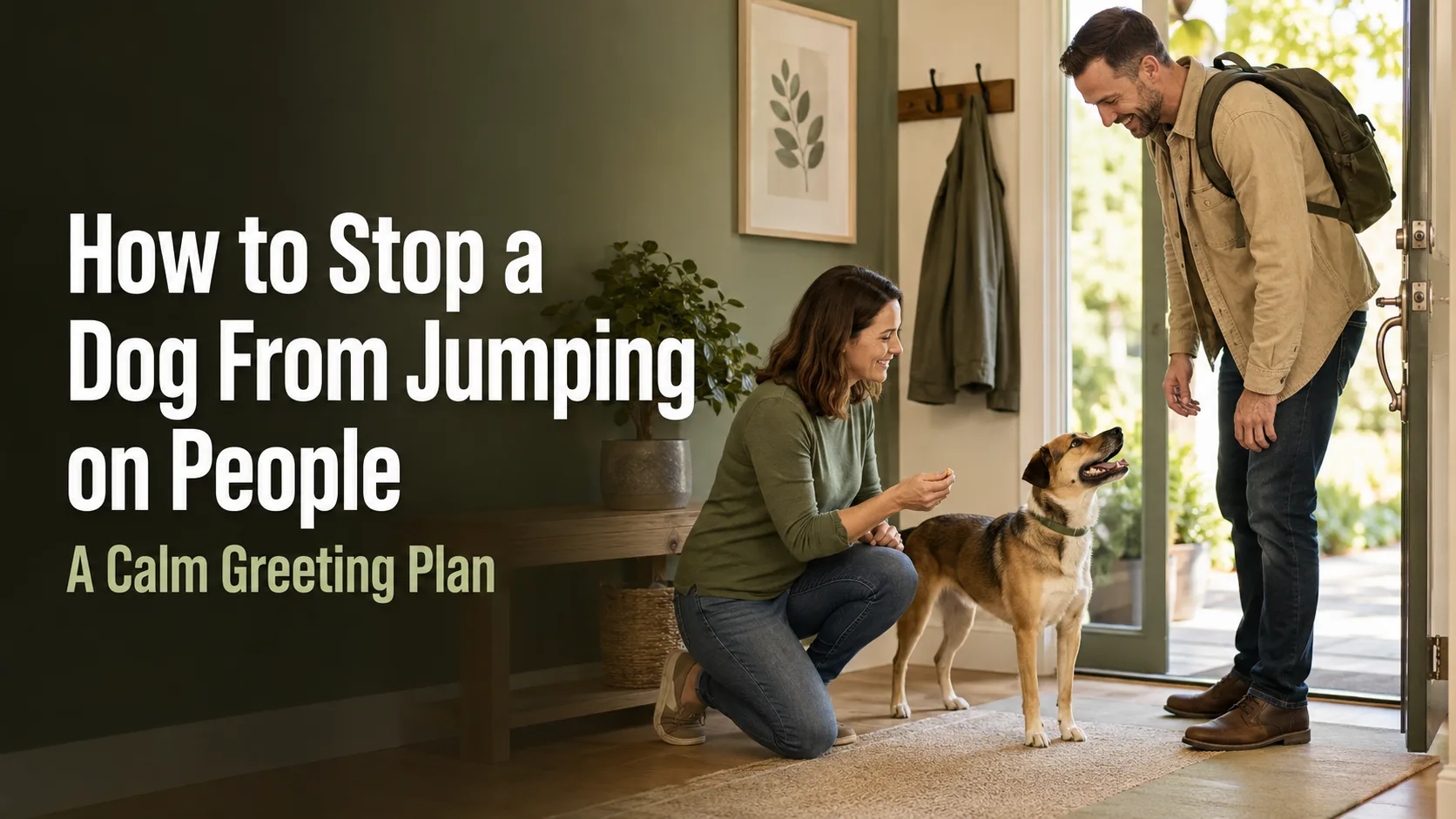
Quick answer: Prevent jumping from earning attention and teach an alternative that can earn greeting. Use a gate, lead, or distance before the person enters; reward four paws on the floor or a mat; and have the visitor approach only while the dog remains grounded. If the dog jumps, the person calmly turns or steps away and the setup becomes easier.
Jumping persists because it often works. Even pushing, talking, eye contact, or laughter can be rewarding to an excited dog. Telling the dog not to jump while allowing occasional enthusiastic greetings creates a durable variable reinforcement schedule.
The solution combines management with rehearsal of a behavior that is physically and emotionally possible. A frantic dog at the open door may need distance and a barrier before they can offer a sit.
Why Dogs Jump
- To reach faces and social contact during greeting.
- Because people touch, talk, push, or laugh when it happens.
- High arousal, frustration, anxiety, or lack of impulse-control practice.
- The alternative behavior has only been practiced when no visitor is present.
- Puppy jumping was encouraged when the dog was small.
Choose the Alternative Behavior
Four paws on the floor is often easier than requiring a sit. A mat or station adds a clear location and distance. Choose one primary greeting plan so every household member can apply it.
Do not insist on a sit if the dog finds sitting uncomfortable or becomes more frustrated. The goal is a safe grounded body and the ability to disengage.
Set Up the Door Before It Opens
- Exercise and toilet the dog appropriately before planned visitors.
- Prepare high-value rewards and place a gate, pen, or lead well before the knock.
- Cue the mat or reward four paws down at a safe distance.
- Let the visitor enter without staring, reaching, or speaking to the dog.
- Approach in small steps; retreat immediately if the dog jumps or loses control.
Teach Four Paws on the Floor
With a familiar helper, have the person stand still several feet away. Mark and reward while the dog has four paws down. The helper takes one step closer. If paws stay down, mark and allow brief greeting. If the dog jumps, the helper turns and steps away without scolding.
Reset far enough away to succeed. Ten easy approaches teach more than one chaotic doorway confrontation.
Teach a Greeting Station
- Build value for stepping onto and relaxing on a mat with no visitor.
- Add the door handle moving, then the door opening slightly.
- Add a familiar person outside at a distance.
- Reward on the mat while the person enters and sits.
- Release for a brief greeting only if the dog can remain grounded; return to the mat afterward.
Visitor Script
| Dog behavior | Visitor response | Handler response |
| Four paws down | Approach sideways and greet briefly | Mark and reward |
| Begins to bounce | Pause or step back | Increase distance; reward ground contact |
| Jumps | Turn and withdraw attention | Reset behind barrier without scolding |
| Cannot settle | Ignore and sit away | Give decompression break or enrichment |
| Shows fear/aggression | Stop approach | Secure space and seek professional help |
Puppies and Children
Do not use a child as the practice helper for an excitable dog. Adults should train the behavior first. Use barriers and keep greetings short. A jumping dog can knock a child down even when friendly.
Teach children to stand still, protect their face, and call an adult rather than pushing, running, or squealing. Active adult supervision is required.
What Not to Do
- Do not knee the chest, step on paws, shout, or use leash corrections.
- Do not ask visitors to tolerate repeated jumping while the dog ‘gets it out of their system.’
- Do not reward a sit and then allow jumping during the actual greeting.
- Do not use the crate as punishment after the dog fails at an overly difficult setup.
- Do not force contact when jumping is driven by conflict, fear, or panic.
Practice Without Real Visitors
Rehearse the doorbell at low volume, door movements, picking up keys, walking to the mat, and a helper entering repeatedly. These component skills reduce the number of surprises in the complete event.
Use the clicker training guide to capture four paws and mat behavior. Keep practice predictable before adding delivery drivers or large gatherings.
When Jumping Is More Than Excitement
Jumping combined with hard mouthing, growling, frantic pacing, barking, hiding, or inability to recover may involve fear, frustration, or anxiety. Sudden behavior can also be linked to pain or medical change.
Use physical separation for safety and seek a veterinarian and qualified behavior professional. Do not invite more visitors to test the dog.
Frequently Asked Questions
Should I ignore my dog when they jump?
With ordinary social jumping, remove attention calmly while also preventing rehearsal and teaching a rewarded alternative. Ignoring alone may be unsafe or too difficult.
Is sit required for polite greeting?
No. Four paws on the floor or a station behavior may be easier and safer. Choose the behavior the dog can perform comfortably.
Why does my dog jump only on some people?
Those people may move, speak, or reward differently, or the dog may feel more excited or conflicted around them. Train with controlled helpers and clear scripts.
How do I stop jumping on strangers during walks?
Create distance, prevent surprise greetings, reward check-ins and ground contact, and allow approach only when the dog is calm. Not every person needs to greet.
Will turning my back stop jumping?
It can remove attention, but the dog also needs management and reinforcement for what to do instead. Some dogs circle, mouth, or jump harder, so use a barrier or lead safely.
How long does it take to stop jumping?
Early improvement can occur quickly when everyone is consistent, but reliability with real visitors takes repeated staged practice and prevention of accidental rewards.
What if my dog jumps and growls?
Stop greetings and create safe separation. Growling may signal fear or conflict. Seek veterinary and qualified behavior guidance rather than treating it as simple excitement.
Disclaimer
Medical and behavior disclaimer: This article provides general education, not an individualized behavior diagnosis or treatment plan. Pain, illness, fear, and anxiety can change behavior, so contact a veterinarian when a behavior is sudden, severe, escalating, or accompanied by physical symptoms. Do not use intimidation, physical corrections, shock, prong, or choke-based methods. If a dog has bitten, threatens to bite, guards resources, panics, or cannot be safely managed, work with a veterinarian and a credentialed reward-based behavior professional.