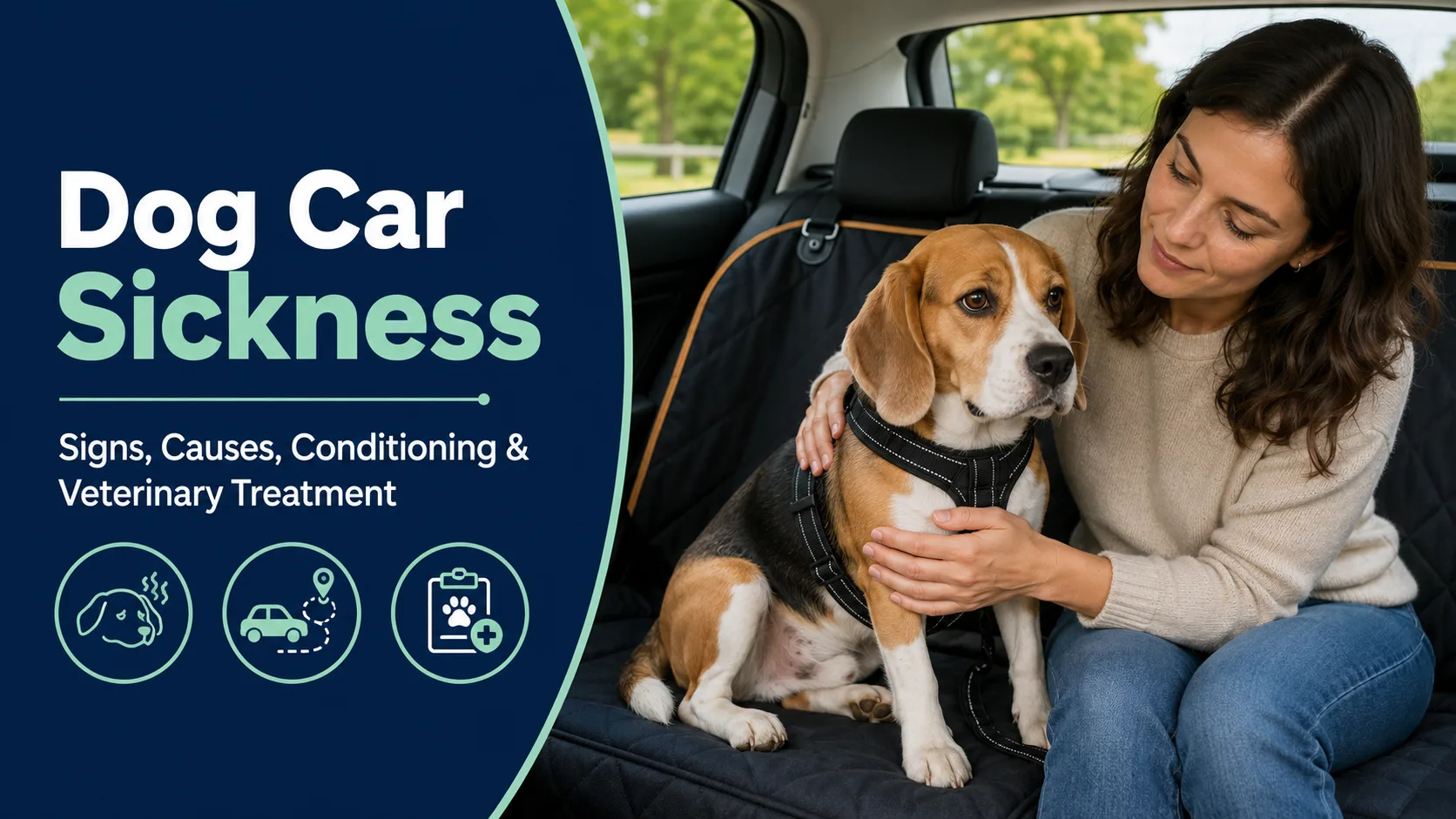
Quick answer: Dog car sickness can cause drooling, lip licking, yawning, whining, restlessness, nausea, vomiting, diarrhea, or poor appetite after travel. Fear may occur with or without motion sickness. Stop repeated long drives, ask a veterinarian to rule out medical problems and discuss anti-nausea treatment, and rebuild the car association through stationary sessions and very short trips below the dog’s threshold.
A dog who vomits in the car may begin to fear the car, and a dog who fears the car may show nausea-like signs before the vehicle moves. Treating only one side can leave the cycle intact.
The first step is observation: record when signs begin, whether the car is moving, the route, meal timing, temperature, restraint, direction the dog faces, and recovery time.
Signs of Motion Sickness
The Merck Veterinary Manual notes that motion sickness occurs during land, sea, or air travel and signs typically resolve when motion stops. Persistent symptoms outside travel, blood, pain, collapse, or repeated vomiting requires veterinary evaluation.
- Excessive drooling, lip licking, swallowing, yawning, or licking surfaces.
- Whining, restlessness, trembling, uneasiness, or trying to escape.
- Nausea, retching, vomiting, diarrhea, or poor appetite after travel.
- Lethargy or reluctance to enter the vehicle after repeated bad experiences.
Motion Sickness vs Travel Anxiety
| Pattern | More consistent with | Next step |
| Signs begin only after turns/motion | Motion sickness | Veterinary assessment + gradual conditioning |
| Signs begin near keys, garage, or parked car | Learned fear/anxiety | Below-threshold counterconditioning |
| Both patterns occur | Combined nausea and fear | Treat both with vet/behavior plan |
| Symptoms occur away from car | Other medical cause possible | Veterinary examination |
Why Puppies May Be More Susceptible
Young dogs may have more motion sensitivity and less travel experience. A few vomiting episodes can quickly condition fear of the carrier, car, road, or pre-trip cues.
Do not assume the puppy will ‘grow out of it’ while continuing distressing journeys. Early veterinary and conditioning support can prevent a stronger learned response.
Rule Out Other Problems
Vomiting and drooling can have causes unrelated to motion, including gastrointestinal disease, toxin exposure, pain, vestibular problems, heat illness, or medication effects. Tell the veterinarian about symptoms outside travel, head tilt, balance changes, ear problems, appetite, stool, and weight.
An unsafe or cramped restraint, poor ventilation, exhaust exposure, heat, and aggressive driving can also worsen symptoms.
A Gradual Car Conditioning Plan
- Approach the parked car from a distance where the dog remains comfortable; reward and leave.
- Progress to standing beside the car, then entering briefly with doors open.
- Feed or offer enrichment in the stationary car without turning it on.
- Start the engine for seconds, reward calm behavior, and end.
- Drive a few metres, then around the block, ending before symptoms appear.
- Increase duration slowly and include destinations the dog enjoys, not only the veterinarian.
Travel-Day Management
- Use a safe certified restraint or secured crate and maintain comfortable ventilation.
- Drive smoothly, avoid abrupt turns and braking, and choose a lower-curve route when possible.
- Follow veterinarian advice about meal timing; do not fast puppies or medically managed dogs without direction.
- Keep the cabin cool and stop safely at the earliest signs rather than waiting for vomiting.
- Bring liners, towels, water, cleaning supplies, and medication exactly as prescribed.
Veterinary Treatment Discussion
Veterinarians may consider anti-nausea medication, anxiety treatment, or both after assessing the dog. The choice, dose, timing, contraindications, and trial plan are individual. Some medications marketed as sedating do not reliably relieve nausea or fear.
Never copy a dose from another dog, a human label, or an online calculator. Tell the veterinarian about all conditions, supplements, and medications.
What Not to Do
- Do not force repeated long trips so the dog ‘gets used to it.’
- Do not punish vomiting, drooling, whining, or refusal to enter.
- Do not let the dog ride loose or put its head out of the window.
- Do not give human motion-sickness drugs, antihistamines, sedatives, ginger, or CBD without veterinary approval.
- Do not feed a large unfamiliar meal before travel.
Progress Log
| Record | Example |
| Pre-trip state | Relaxed, ate normal meal, temperature mild |
| First sign and time | Lip licking at 4 minutes |
| Motion context | After roundabout or winding road |
| Intervention | Stopped, water offered, session ended |
| Recovery | Settled in 15 minutes, appetite normal |
| Next criterion | Two-minute straight drive with vet plan |
When It Is Urgent
- Repeated vomiting or inability to keep water down.
- Collapse, severe weakness, breathing difficulty, abnormal gum color, or heat exposure.
- Head tilt, loss of balance, seizures, or other neurologic signs.
- Blood, swollen abdomen, severe pain, toxin concern, or symptoms unrelated to travel.
Frequently Asked Questions
Do dogs grow out of car sickness?
Some puppies improve with maturity, but repeated illness can create learned fear. Use veterinary guidance and gradual conditioning rather than waiting through distress.
Should a dog travel on an empty stomach?
Meal timing is individual. Ask the veterinarian, especially for puppies, diabetes, medication needs, or bloat risk. Do not improvise prolonged fasting.
Can anxiety make a dog vomit in the car?
Yes. Fear and motion sickness can coexist and reinforce one another. Signs that begin before motion suggest a learned emotional component.
What medicine can I give my dog?
Only medication prescribed or approved by the veterinarian for that dog. Human products and doses can be unsafe or interact with other conditions.
Does facing forward help?
Position and visual input may affect some dogs, but safety comes first. Do not change a certified restraint configuration. Discuss setup and symptoms with the veterinarian.
How short should training drives be?
Short enough to end before signs appear—even seconds or a driveway movement at first. Progress by the dog’s response, not a fixed calendar.
When should vomiting after a car ride be treated as urgent?
Repeated vomiting, inability to keep water down, blood, pain, collapse, severe weakness, breathing changes, heat exposure, or symptoms continuing away from travel needs prompt care.
Disclaimer
Medical and behavior disclaimer: This guide is educational and does not replace veterinary, airline, government, legal, or vehicle-manufacturer advice. Pet-entry rules, health-certificate windows, airline policies, weather embargoes, and product certifications can change. Verify every requirement directly with the airline, destination authority, your veterinarian, and the product manufacturer before travel. Never give sedatives, antihistamines, or anti-nausea medication unless your veterinarian has prescribed the specific drug and dose for your dog.