
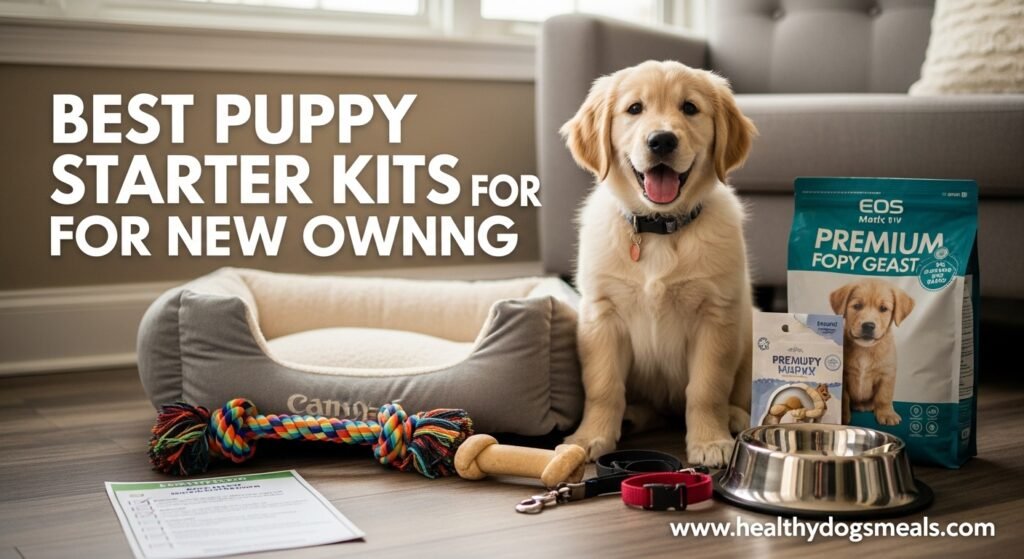
The best puppy starter kit is one that contains items your puppy can safely use now, at a lower total cost than buying the useful items separately. A large bundle is poor value if the harness does not fit, the toys are unsuitable or you need to replace the food immediately.
For many owners, a small bundle plus individually selected essentials is a practical approach. Start with appropriate food, water and feeding supplies, a safe resting area, secure handling and travel equipment, and a few suitable toys. Keep money available for veterinary care and ongoing supplies.
This is a research-based buying guide. The examples below are based on published manufacturer or retailer descriptions, not hands-on testing, and are not ranked as independently tested winners.
Which Type of Puppy Starter Kit Do You Need?
| Kit approach | Useful when | What to check carefully |
|---|---|---|
| General supplies bundle | You need several everyday items | Exact sizes, contents and missing essentials |
| Toy and enrichment bundle | You already have bowls, bedding and handling equipment | Toy dimensions, chewing style and treat suitability |
| Crate-based bundle | You have chosen to introduce a crate and need matching accessories | Crate size, divider, ventilation and what is actually included |
| Build your own kit | You need specific sizes or already own some supplies | Total delivered cost and avoiding duplicate purchases |
A “starter pack” might be a few toys, a food promotion or a more substantial supplies bundle. Read the itemised contents rather than relying on the name.
For planning beyond the shopping list, our first week with a new puppy guide helps organise arrival, sleep, meals and quieter introductions.
Two Real Puppy Bundle Examples
MidWest Puppy Starter Kit: A US Supplies Example
The MidWest manufacturer’s Starter Kit page lists a small version containing a 24-inch mat, two 10-ounce bowls, seven training pads, KONG toys, a puppy brush, and a Coastal collar and leash.
The displayed small version is described for dogs expected to be around 25 lb as adults. The page also offers other size selections, so confirm the contents and dimensions of the exact version you order.
Why consider it: it groups several ordinary supplies into one purchase if you need those particular items.
What to check: the listed bundle does not establish that a crate, puppy food, harness or travel restraint is included. Bowl capacity, collar fit and each toy still need to suit your puppy. Do not confuse this supplies kit with the company’s separate crate products or crate bundles.
KONG Puppy Pack Essentials: An Australian Enrichment Example
The Aussie Pooch Direct listing for KONG Puppy Pack Essentials describes a bundle containing a medium Puppy KONG, Puppy Easy Treat, a Puppy Wubba and a small bowl.
Why consider it: it may suit an owner looking for an enrichment-focused addition after the main home setup is arranged.
What to check: this is not a complete household starter kit. The listed contents do not include a bed, lead, collar, complete puppy food or a second bowl. The specified toy sizes and edible products must be appropriate for your individual puppy.
Check the current product contents and checkout price. Retailers can change bundles, substitute items or display older promotional wording. Neither the brand name nor a “puppy” label makes every item suitable for every puppy.
Build Your Own Kit: The Flexible Alternative
Buying separately lets you retain the puppy’s familiar suitable food, choose a well-fitting harness and avoid duplicate bowls or unnecessary grooming products.
It can also make sense for a very small puppy, a puppy that will grow quickly, or a dog with an existing dietary restriction. You do not need matching colours or a gift box for a functional setup.
Your Essential Puppy Shopping Checklist
| Category | What to arrange | Buying check |
|---|---|---|
| Food | The puppy’s current suitable complete growth food | Confirm the exact recipe, life stage and feeding history |
| Bowls | Separate washable food and water bowls | Stable, accessible and appropriately sized |
| Measuring | A kitchen scale and simple feeding record | Use the food’s actual calorie information |
| Resting space | Washable bedding and a puppy-safe area | Consider chewing, loose threads and easy cleaning |
| Handling | Properly fitted harness or collar, lead and ID | Measure the puppy; recheck fit as they grow |
| Travel | An appropriate carrier or vehicle restraint | Home crates and car restraints have different jobs |
| Play | A few suitable toys | Check dimensions, loose parts and chewing strength |
| Cleaning | Waste bags and suitable accident cleaner | Store cleaning products out of reach |
| Grooming | Coat-appropriate brush and dog-use products as needed | Avoid buying a large grooming set before checking coat needs |
| Records | Veterinary appointment and health paperwork | Bring food, vaccination and previous medication details |
Our broader puppy care guide connects these purchases with the ongoing work of caring for a growing dog.
Puppy Food: The Bundle Is Not the Decision
Ask the breeder, rescue or previous caregiver for the exact food name and feeding routine. Where that food is appropriate, keeping it familiar initially can simplify the move. If it is unsuitable, ask your veterinarian how to change it.
Check the food’s nutritional purpose, not just its first ingredient. A suitable growth food or an appropriate all-life-stages food can meet puppy needs; adult-maintenance food alone is not a substitute. Large-breed growth suitability needs a specific check.
AAFCO does not approve starter kits, toys or brands. US nutritional-adequacy wording is relevant to the food’s stated purpose, and an Australian product needs its own local-label assessment.
Use our puppy feeding guide to understand meal frequency and measured portions. A free food sample is a marketing inclusion, not an obligation to switch your puppy’s diet.
Toys and Treats: Match the Puppy in Front of You
Choose toys that are difficult for your puppy to swallow whole and suited to their chewing style. Inspect them regularly and remove damaged items or loose pieces. Supervision remains important even when packaging says “durable.”
For edible products, check ingredients, age guidance and calories. The treats and stuffing included in a kit are extras, not a complete meal. Part of the normal daily food allowance can often be used for training instead.
Start with a small number of toys and learn what the puppy enjoys. There is no need to open every toy and every new treat on the first evening.
Our reward-based training basics explain how to make those rewards useful. A clicker is optional; our clicker-training guide explains what it does before you buy one.
Beds, Pens and Crates
A puppy needs a quiet, comfortable place to rest. A safe pen or gated area may be useful, and a crate is an option when introduced positively and used appropriately.
If using a crate, the puppy should have room to stand naturally, turn around and lie comfortably. Check ventilation and supervise the introduction. Consider whether a divider can help accommodate growth without buying several crates.
Avoid items that can snag or become entangled in crate or pen hardware, and inspect bedding for swallowed fabric or exposed filling. A crate should not be used to avoid arranging appropriate toileting, meals, water and human care.
A wire home crate is not automatically a protective car crate. Our dog car restraint and travel-crate guide explains why the exact product and installation matter.
Grooming: Buy for the Coat You Have
A soft brush included in a kit may be a useful introduction to handling, but it may not be enough for every coat type. Long, curly, double and smooth coats can require different tools and routines.
Ask a groomer or veterinarian to demonstrate gentle brushing and nail care. Choose dog-use toothpaste for dental care and a suitable dog shampoo when needed. Avoid treating ear cleaners, supplements or parasite products as automatic purchases for every puppy.
Our coat-based brushing guide can help you identify questions before buying a large grooming set.
Are Puppy Starter Kits Actually Cheaper?
Sometimes, but the saving must be calculated from items you genuinely need.
Useful comparison: kit price + missing essentials + delivery = your real setup cost.
For a hypothetical example in one currency, a 70-unit bundle plus 30 units of missing supplies costs 100 units. If the useful items bought individually cost 90 units delivered, the bundle does not save money. This is an illustration, not a current USD or AUD price quote.
Compare the same sizes and usable quantities. A tiny bowl, an ill-fitting harness and several unwanted toys should not be valued as though they were suitable replacements for your shopping list.
Keep US prices in USD and Australian prices in AUD. Check local shipping, returns and replacement sizes before buying internationally.
The Essentials a Box Cannot Provide
Arrange an early veterinary appointment and bring the puppy’s records. Ask about vaccinations, parasite prevention, feeding and any immediate concerns. Our puppy vaccination guide helps you prepare questions without replacing a local veterinary plan.
Social learning also needs a plan. Ask your veterinarian which outings and classes fit your puppy’s vaccination status and local disease risk. Our puppy socialisation guide explains gentle, positive introductions.
You can begin simple reward-based lessons in a quiet, safe space. Our guide to teaching basic commands is useful once your puppy has time to settle.
Frequently Asked Questions
Do I need to buy a starter kit at all?
No. A carefully chosen set of individual supplies can work just as well. Convenience and usable value are the reasons to buy a bundle.
Does a large-breed kit guarantee the food is suitable?
No. Equipment sizing and nutritional suitability are separate checks. Read the exact food label and ask your veterinarian about large-breed growth requirements.
Should I buy everything before collection day?
Have essential food, bowls, a safe resting space, handling equipment and a transport plan ready. Buy optional extras after learning more about your puppy.
Are puppy pads essential?
Not for every household. Their usefulness depends on your toileting plan, access to a suitable area and the puppy’s needs. A small pack in a bundle is not a complete toilet-training plan.
Can I use the collar and lead without checking fit?
No. Measure and follow the manufacturer’s fitting instructions. Recheck frequently as the puppy grows, and replace equipment when it no longer fits or becomes damaged.
Disclaimer: This buying guide provides general information, not individualized veterinary or behaviour advice. Product suitability depends on your puppy’s size, development, health and supervision. Consult your veterinarian about nutrition, symptoms, medications and preventative care.
Leave a Reply