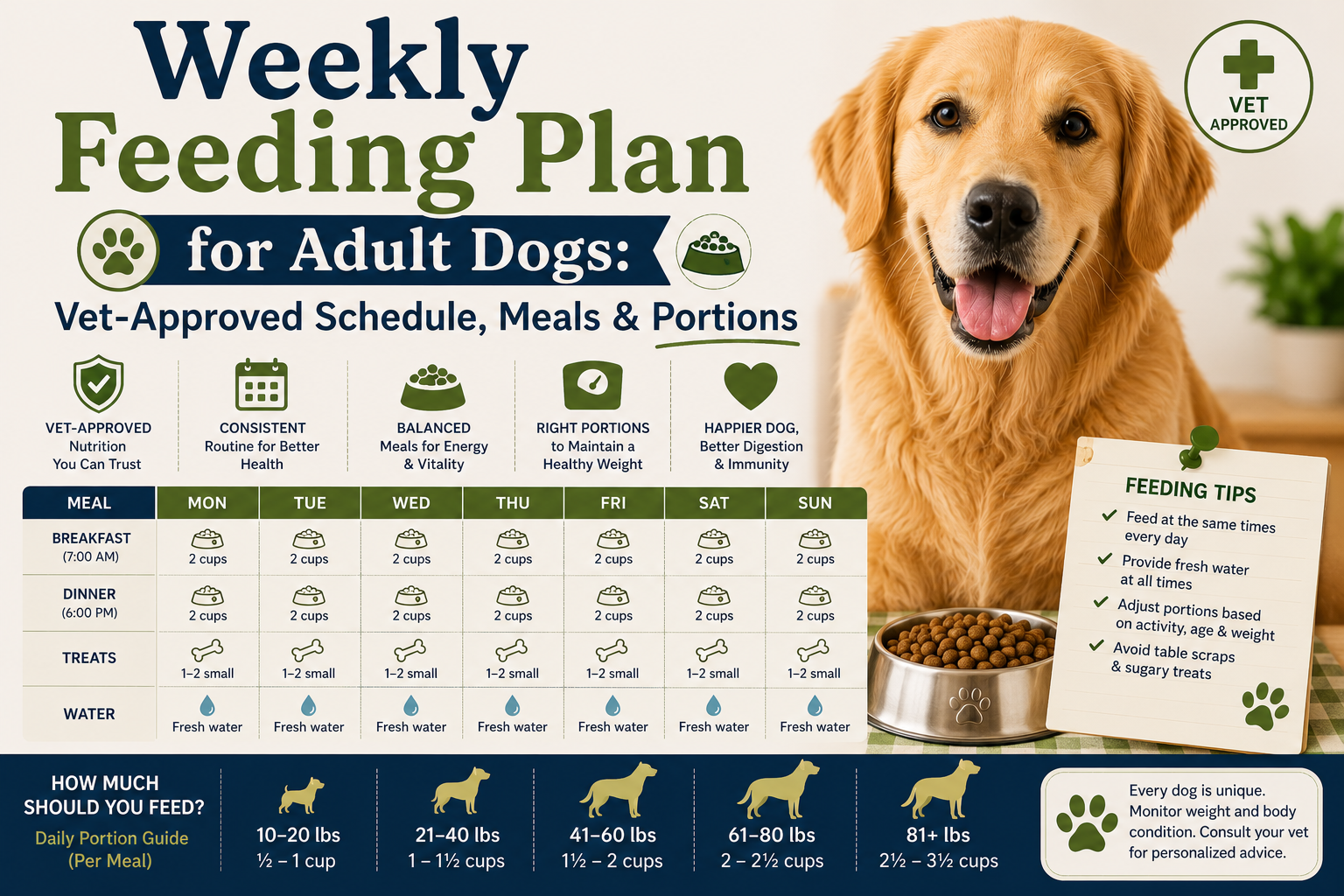
Quick Answer: Adult dogs (ages 1–7) should be fed twice daily — morning and evening — using a rotating protein base of high-quality kibble plus whole-food toppers. A structured weekly plan prevents overfeeding, nutritional gaps, and digestive upset. Scroll down for a free 7-day meal chart.
1. Why Adult Dogs Need a Structured Feeding Plan {#why}
Adult dogs — typically between 1 and 7 years of age — have stable but specific nutritional needs. Without a feeding plan, it’s easy to fall into habits that quietly harm your dog: inconsistent portion sizes, missed supplements, too many treats, or a monotonous single-protein diet that leaves nutritional gaps over months and years.
A structured weekly feeding plan:
- Prevents obesity — over 56% of dogs in the U.S. are overweight or obese, according to the Association for Pet Obesity Prevention
- Supports digestive health — consistent meal timing regulates gut motility and reduces gas and bloating
- Makes health monitoring easier — when your dog eats the same structured amount daily, any change in appetite is immediately noticeable
- Reduces food sensitivities over time — rotating proteins prevents overexposure to a single ingredient
If you’re still figuring out your dog’s overall diet, our 7-Day Balanced Dog Meal Plan is a great companion to this guide. And once you have the plan in place, consult our Portion Guide by Dog Weight to dial in exact amounts.
2. How Often Should You Feed an Adult Dog?
The gold standard is twice per day — once in the morning and once in the evening, roughly 8–12 hours apart. This is recommended by most veterinary nutritionists because it:
- Maintains stable blood sugar throughout the day
- Reduces the risk of gastric dilatation-volvulus (bloat) in large and deep-chested breeds like Great Danes, Boxers, and German Shepherds
- Supports better digestion compared to one large daily meal
- Reduces hunger-driven anxiety and begging
The American Kennel Club also recommends twice-daily feeding for most adult dogs.
| Feeding Schedule | Pros | Cons | Best For |
|---|---|---|---|
| Twice daily (AM + PM) | Stable blood sugar, good digestion | Requires timing consistency | Most adult dogs ✅ |
| Once daily | Simple, convenient | Hunger spikes, bloat risk | Only if vet-recommended |
| Three times daily | Great for high-energy or small breeds | More time-intensive | Active or toy-breed dogs |
| Free feeding | Low maintenance | Obesity risk, no monitoring | Generally NOT recommended ❌ |
Pro tip: Feed at the same times every day. Dogs have strong circadian rhythms — consistent timing reduces stress, supports housetraining, and keeps digestion regular.
3. How Much Should You Feed? Portions by Weight
Portion size depends on your dog’s weight, age, activity level, and the caloric density of the food. Most adult dry kibbles contain 320–400 calories per cup.
As a general starting baseline:
| Dog Weight | Daily Calories (Avg.) | Kibble Per Day (350 kcal/cup) |
|---|---|---|
| 10 lbs | ~350 kcal | ~1 cup |
| 25 lbs | ~650 kcal | ~1.75 cups |
| 35 lbs | ~900 kcal | ~2.5 cups |
| 50 lbs | ~1,200 kcal | ~3.5 cups |
| 75 lbs | ~1,700 kcal | ~5 cups |
⚠️ These are estimates only. Always check the feeding guidelines on your specific food’s packaging and consult your vet for precision — especially for senior dogs, nursing dogs, or dogs recovering from illness.
For a more precise breakdown, visit our Portion Guide by Dog Weight, which covers every weight range from 5 lbs to 100+ lbs.
4. Complete 7-Day Weekly Feeding Plan
Below is a sample weekly feeding plan for a 35-pound active adult dog needing approximately 900 calories/day (split into two 450-calorie meals). Adjust portions up or down based on your dog’s actual weight.
| Day | AM Meal | PM Meal | Daily Supplement |
|---|---|---|---|
| Monday | ¾ cup kibble + 2 oz boiled chicken | ¾ cup kibble + steamed green beans (¼ cup) | Fish oil (1,000mg) |
| Tuesday | ¾ cup kibble + 1 scrambled egg | ¾ cup kibble + 2 tbsp sweet potato mash | Probiotic |
| Wednesday | ¾ cup kibble + 1 tbsp canned tuna (in water) | ¾ cup kibble + 2 oz shredded turkey | Fish oil (1,000mg) |
| Thursday | ¾ cup kibble + raw chopped carrots (¼ cup) | ¾ cup kibble + 2 oz lean boiled beef | None |
| Friday | ¾ cup kibble + 1 tbsp plain pumpkin purée | ¾ cup kibble + chicken breast + peas (2 tbsp) | Fish oil (1,000mg) |
| Saturday | ¾ cup kibble + 1 egg yolk drizzle | ¾ cup kibble + 2 oz ground turkey (cooked) | Probiotic |
| Sunday | ¾ cup kibble + ¼ cup mixed frozen veg (thawed) | ¾ cup kibble + 1.5 oz cooked salmon | Fish oil (1,000mg) |
Notes on this plan:
- Kibble base is a high-quality adult formula (e.g., Purina Pro Plan or Royal Canin Adult)
- All meat is plainly cooked — no salt, garlic, onion, or seasoning
- Toppers add approximately 50–80 calories per meal; reduce kibble slightly if your dog is gaining weight
- Rotate fish oil and probiotic on alternating days to avoid over-supplementation
5. Protein Rotation: Why It Matters
Protein rotation is one of the most underused strategies in home dog feeding, yet it delivers real long-term benefits.
Different proteins provide different amino acid profiles, fat compositions, and trace minerals:
- Chicken — lean, high in niacin and B6, easy to digest
- Turkey — similar to chicken but slightly higher in tryptophan (supports calm behavior)
- Beef — rich in zinc, iron, and creatine; higher fat content (great for active dogs)
- Salmon / fish — excellent omega-3 source; supports skin, coat, and joint health
- Eggs — the most bioavailable complete protein available; rich in choline
Rotating these proteins across the week — as shown in the plan above — ensures your dog benefits from the full spectrum of nutrients rather than being over-reliant on one source.
It also reduces the risk of food sensitivities. Dogs that eat the same protein every day for years can develop intolerances to it. The Journal of Veterinary Internal Medicine has published research linking chronic single-protein diets with increased allergic dermatitis in dogs.
Want to dig deeper? Read our guide on Rotational Diets for Dogs for a full breakdown of how to structure protein rotation safely.
6. Safe Whole-Food Toppers to Boost Nutrition
Adding whole foods to your dog’s kibble base is an easy, affordable way to increase nutrient density and keep mealtimes exciting. Here are safe, vet-approved options:
Vegetables ✅
- Steamed green beans — low calorie, high fiber; excellent for weight management
- Plain pumpkin purée — regulates digestion; great for both loose stools and constipation
- Carrots (raw or cooked) — rich in beta-carotene and great for dental health
- Peas (fresh or frozen) — good source of plant-based protein and vitamin K
- Broccoli (in small amounts) — high in vitamin C but gas-forming in large portions
Proteins ✅
- Boiled chicken breast — the gold standard lean topper
- Cooked salmon — excellent omega-3 fatty acids; use canned in water or fresh cooked
- Scrambled or hard-boiled eggs — complete protein, no added butter or salt
- Plain cooked turkey — lean and digestible
Other Safe Additions ✅
- Plain Greek yogurt (1–2 tsp) — natural probiotic, only if your dog tolerates dairy
- Coconut oil (½ tsp) — MCT fats support coat health
- Bone broth (unsalted, onion-free) — hydration boost and palatability enhancer
Foods to Always Avoid ❌
Never add these to your dog’s meals — they’re toxic:
- Onions, garlic, leeks, chives
- Grapes, raisins, or currants
- Macadamia nuts
- Xylitol (in any form)
- Avocado (skin, pit, and flesh)
- Chocolate
For a full breakdown of which human foods are safe, visit our Can Dogs Eat? resource library — it covers over 100 individual foods with safety ratings.
7. How to Handle Treats Within the Weekly Plan
Treats should never exceed 10% of your dog’s total daily caloric intake. For a 35-pound dog eating 900 calories a day, that’s a maximum of 90 calories in treats.
To put that in perspective:
- 1 Milk-Bone small biscuit ≈ 40 calories
- 1 piece of freeze-dried chicken ≈ 5–10 calories
- 1 commercial training treat (e.g., Zuke’s Mini) ≈ 3.5 calories
Best practices for treat management:
- Use single-ingredient treats — freeze-dried chicken, sweet potato chews, dehydrated liver
- On heavy training days, reduce kibble by an equal caloric amount rather than adding treats on top of full meals
- Avoid treats with sodium, artificial colors, BHA, BHT, or propylene glycol
- Use carrot sticks or plain rice cakes as very low-calorie reward options
8. Signs Your Weekly Feeding Plan Is Working
After 2–4 weeks on a structured plan, you should see these positive signs:
✅ Consistent, well-formed stools — not too soft, not too hard; Type 3–4 on the Bristol Stool Chart
✅ Stable body weight — you can feel ribs with gentle pressure but not see them (Body Condition Score 4–5/9)
✅ Shiny, low-shedding coat — a sign of adequate protein, fat, and omega-3 intake
✅ High energy during play, calm at rest — no post-meal lethargy or pre-meal agitation
✅ No excessive begging, gas, or mid-night vomiting — a sign of good portion balance
If you’re seeing the opposite — dull coat, loose stools, weight gain or loss, or behavioral anxiety around meals — it may be time to revisit portions or check the quality of your base kibble. Our Dog Food Guide can help you evaluate what you’re feeding.
9. Common Feeding Mistakes to Avoid
Even well-intentioned dog owners make these mistakes:
1. Eyeballing portions instead of measuring
Using a scoop “by feel” leads to portion drift over weeks. Use a proper measuring cup or kitchen scale.
2. Changing food too quickly
Switching proteins or brands without a 7–10 day transition causes digestive upset. Always blend old and new food gradually.
3. Ignoring treat calories in the total daily count
Many owners feed a full diet AND give generous treats, not realizing they’re overfeeding by 20–30%.
4. Feeding from the table
Human food is often too salty, fatty, or seasoned for dogs. It also teaches begging behavior and disrupts the structured plan.
5. Supplements without guidance
Over-supplementing with calcium, vitamin D, or fat-soluble vitamins can be as harmful as deficiency. Stick to fish oil and probiotics as safe defaults unless your vet advises otherwise.
10. Recommended Products for Weekly Meal Planning
| Product | Why We Recommend It | Where to Buy |
|---|---|---|
| Purina Pro Plan Adult Dry Dog Food | Research-backed formula, vet-recommended, real meat as first ingredient | Amazon / Chewy |
| Blue Buffalo Life Protection Adult | Whole meat first, no by-product meals, widely available | Chewy.com |
| Royal Canin Size Health Nutrition | Breed-size specific formulas with precise nutrient profiles | PetSmart / Chewy |
| Pet Honesty Omega-3 Fish Oil Softchews | Easy daily omega-3 supplement, no fishy mess | Amazon.com |
| Zuke’s Mini Naturals Training Treats | Only 3.5 cal per treat; ideal for training-heavy weeks | Amazon / Petco |
Affiliate Disclosure: This article may contain affiliate links. If you purchase through these links, we may earn a small commission at no extra cost to you. This never affects our editorial recommendations.
11. Frequently Asked Questions
A: Transition gradually over 7–10 days. Start with 75% old food and 25% new, then shift to 50/50 by day 4, and 25% old / 75% new by day 7. A full switch by day 10 minimizes digestive upset.
A: Yes, within a 30-minute window is ideal. Dogs have strong internal clocks. Consistent feeding times reduce anxiety, help with housetraining, and support circadian digestive rhythms.
A: Missing one meal occasionally isn’t cause for alarm — it happens. If your dog refuses two or more consecutive meals, or shows other signs like lethargy or vomiting, consult your vet promptly.
A: Reduce total daily calories by 10–15%. Increase fiber-rich toppers like plain pumpkin and steamed green beans — both are very low in calories but add volume and satiety.
A: Yes. Wet food increases moisture intake (important for kidney health) and palatability. Replace a portion of kibble with wet food of equivalent caloric value. A 50/50 mix works well for most dogs.
A: Review every 3–6 months, or whenever your dog’s weight, activity level, or health status changes significantly. Senior dogs (7+ years) need a modified plan — see our Best Dog Food for Senior Dogs guide.
A: Yes, but scale portions up using our Portion Guide by Dog Weight. Large breeds may also benefit from breed-specific kibble formulas designed to support joint health.
A: Look for a formula where a named meat (chicken, beef, salmon) is the first ingredient, with an AAFCO statement confirming it’s “complete and nutritionally balanced for adult maintenance.” Check our Dog Food Guide for our vetted picks.
Summary: Your Weekly Feeding Plan Checklist
✅ Feed twice daily, 8–12 hours apart
✅ Measure portions using the calorie guide for your dog’s weight
✅ Use a quality kibble as your base
✅ Rotate proteins across the week (chicken, turkey, beef, fish, eggs)
✅ Add whole-food toppers for nutrition and variety
✅ Keep treats under 10% of daily calories
✅ Review and adjust every 3–6 months
A structured feeding plan is one of the simplest, most impactful things you can do for your dog’s long-term health. Start this week — your dog will thank you for it.
Related Reading on Healthy Dogs Meals:
- 7-Day Balanced Dog Meal Plan
- Portion Guide by Dog Weight
- Rotational Diet Plan for Dogs
- Best Dog Food for Senior Dogs in 2026
- How to Improve Your Dog’s Gut Health Naturally
- Can Dogs Eat? — Full Resource Library
Medical Disclaimer: This content is for informational purposes only and is not a substitute for professional veterinary advice, diagnosis, or treatment. Always consult your veterinarian before making significant changes to your dog’s diet.


One thought on “Weekly Feeding Plan for Adult Dogs: Vet-Approved Schedule, Meals & Portions”