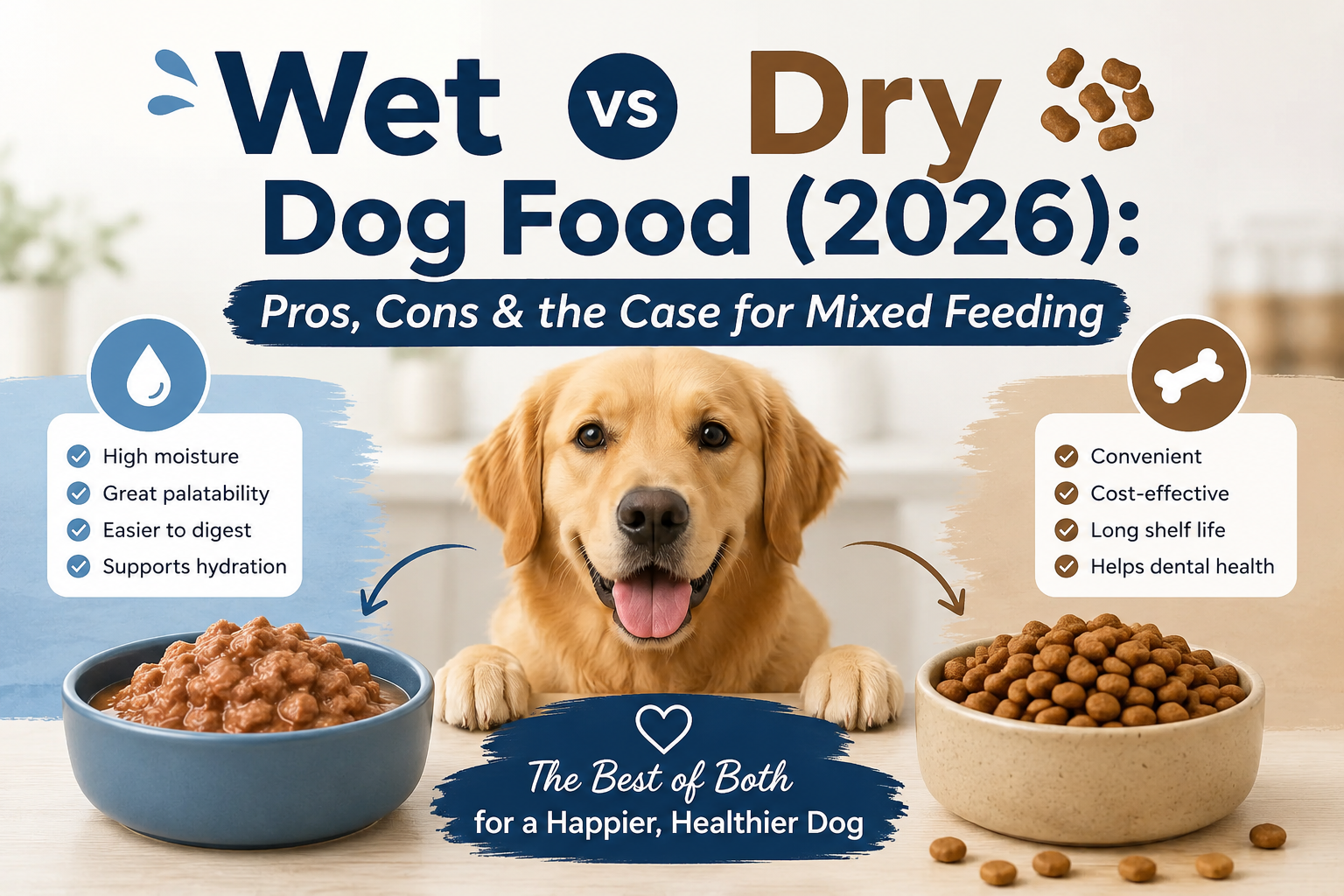
| Quick Answer (AI Overview): Neither wet nor dry dog food is universally “better” — both can deliver complete, balanced nutrition when they carry an AAFCO statement. Dry food (kibble) wins on cost, convenience, storage, and modest dental benefit; wet food wins on hydration (70–80% moisture), palatability, and suitability for seniors, picky eaters, and dogs needing more water intake. For many dogs, mixed feeding — a kibble base topped with measured wet food — captures the best of both. Choose by your dog’s age, health, hydration habits, and your budget, and keep total calories constant whichever route you take. |
| Affiliate Disclosure: This post may contain affiliate links. If you purchase through these links, Healthy Dogs Meals may earn a small commission at no extra cost to you. We only recommend products we genuinely believe can help your dog. Read our full Affiliate Disclosure. |
Walk down any pet food aisle and you’re confronted by the oldest debate in dog nutrition: the wall of kibble bags facing the wall of cans and pouches. Owners ask us constantly which side is “right” — and the honest answer is that wet vs dry dog food is the wrong fight. Both formats can be excellent, both can be terrible, and the real question is which format (or blend) fits *your* dog’s age, teeth, kidneys, waistline, and your household’s budget and routine.
This guide settles the practical questions: exactly how the two formats differ nutritionally, where each genuinely wins, the dental and hydration evidence, cost mathematics on a real 25 kg dog, which dogs strongly suit one format, and how to mix-feed correctly without doubling calories. We compared raw feeding separately in Raw vs Dry Dog Food; this is the everyday wet-vs-kibble decision most owners actually face.
Wet vs Dry: What’s Actually Different?
Strip away marketing and the two formats differ mainly in water content and processing. Kibble is cooked under pressure and dried to roughly 8–10% moisture; wet food is cooked and sealed in cans or pouches at roughly 70–80% moisture. That single difference — water — drives almost everything else: calorie density, portion sizes, palatability, price per calorie, storage, and dental behaviour.
| Factor | Dry Food (Kibble) | Wet Food (Canned/Pouch) |
| Moisture | 8–10% | 70–80% |
| Calorie density | High (~350–420 kcal/cup) | Low (~250–400 kcal per standard can) |
| Cost per calorie | Low — most economical | 2–4× higher typically |
| Palatability | Good | Excellent — aroma and texture win |
| Dental effect | Modest mechanical benefit (esp. dental kibbles) | None; doesn’t clean teeth |
| Hydration support | Minimal — dog must drink | Significant built-in water |
| Storage after opening | Weeks in airtight container | 2–3 days refrigerated |
| Convenience (measuring, travel) | Excellent | Moderate — refrigeration, mess |
| Suits puzzle feeders/training | Excellent | Limited |
| Typical AAFCO completeness | Yes, when stated | Yes, when stated — check “complete” vs “topper” |
One trap deserves bold print: many wet products are “complementary” toppers, not complete diets. A complete food carries an explicit AAFCO (or equivalent) statement that it provides complete and balanced nutrition for a life stage. Feeding a complementary topper as the whole diet slowly starves a dog of micronutrients — our guide to label-reading habits in Fresh vs Rendered pairs well here.
The Case for Dry Food
1. Economics That Scale
Calories are simply cheaper dried. Feeding a 25 kg dog exclusively on quality wet food can cost three to four times the equivalent kibble budget — a difference of well over a thousand dollars a year for large breeds. For multi-dog households and big eaters, kibble keeps quality affordable.
2. Convenience and Precision
Kibble measures precisely (critical for weight control), stores for weeks, travels anywhere, fills puzzle feeders and snuffle mats, and doubles as training currency. Precision matters more than owners realise: weight management lives and dies on measured portions, as we stress throughout our Best Dog Food for Weight Loss guide.
3. A Modest Dental Edge
Chewing kibble provides some mechanical cleaning, and specific dental formulas (larger, fibrous kibbles designed to scrub as they shatter) have evidence behind them. But honesty is owed here: ordinary kibble is not a dental program. No food replaces tooth brushing and veterinary dental care — kibble just loses less ground than wet food does.
Dry Food’s Weaknesses
- Minimal moisture — dogs must drink enough separately, a problem for reluctant drinkers and kidney patients.
- High calorie density makes overfeeding easy: an extra “splash” of kibble is 50+ hidden calories.
- Less aromatic — picky and senior dogs may walk away.
- Quality varies enormously between bags that look identical on the shelf.
The Case for Wet Food
1. Hydration Built Into Every Meal
At 70–80% water, wet food meaningfully contributes to fluid intake. That matters for dogs that under-drink, dogs prone to urinary crystals, seniors, and dogs with kidney disease, where veterinary guidance frequently favours moisture-rich diets. It’s passive hydration the dog can’t refuse.
2. Palatability That Rescues Appetites
Aroma and soft texture make wet food the appetite tool of choice for picky eaters, convalescing dogs, and stressed dogs whose eating has dipped — a pattern we explore in How Stress and Anxiety Can Affect a Dog’s Appetite. A spoon of wet food stirred through kibble revives more dinner bowls than any other trick.
3. Kindness to Aging Mouths
Seniors with worn or missing teeth, small breeds with dental disease, and dogs recovering from extractions eat comfortably on soft food when kibble hurts. Combined with the hydration benefit, this is why wet food features so heavily in senior feeding — see Best Dog Food for Senior Dogs.
4. Satiety Per Calorie
Water bulk means a wet meal looks and feels bigger at the same calories — genuinely useful for dieting dogs and bottomless appetites, where a wet topper makes a restricted ration feel generous.
Wet Food’s Weaknesses
- Cost — the deal-breaker at large-breed volumes.
- Zero dental benefit; exclusively wet-fed dogs need the most diligent dental care.
- Storage and mess: refrigeration after opening, 2–3 day shelf life, bowls that need real washing.
- Many products are complementary toppers, not complete diets — the label trap above.
Mixed Feeding: The Best of Both (Done Correctly)
For a large share of dogs, the smartest answer is both: a measured kibble base for economics, precision and dental contribution, plus a measured wet topper for moisture, satiety and joy. The one iron rule is that calories are a budget, not a bonus — wet food added must be kibble subtracted.
- Find your dog’s daily calorie target (our Dog Food Calculator walks through the maths).
- Choose a split. Popular and practical: 75% of calories from kibble, 25% from wet food.
- Convert to portions. Example: a 1,200 kcal/day dog → 900 kcal kibble (~2.4 cups of a 375 kcal/cup food) + 300 kcal wet (~one standard can, check your label).
- Serve mixed or separately — many owners do kibble mornings (puzzle-feeder friendly) and wet-topped dinners.
- Transition gradually over 7–10 days when introducing wet food to a kibble-only dog, exactly as with any diet change.
- Reassess body condition fortnightly and trim the kibble side first if weight creeps.
| Mixed-Feeding Split | Best For | Watch-Out |
| 90% dry / 10% wet | Budget households wanting palatability boost | Tiny wet portions — freeze leftovers in cubes |
| 75% dry / 25% wet | The all-round sweet spot | Calorie-count the can honestly |
| 50% dry / 50% wet | Picky eaters, under-drinkers | Cost rises; dental care matters more |
| 25% dry / 75% wet | Seniors, dental patients, kidney support (vet-guided) | Significant cost; kibble mostly for texture |
| 100% wet | Vet-directed cases, post-dental recovery | Complete-diet label essential; brush teeth |
Which Format for Which Dog? Quick Decision Guide
| Your Dog | Lean Toward | Why |
| Healthy adult, budget-aware household | Dry (or 90/10 mix) | Economics + convenience, nutrition equal |
| Puppy | Dry puppy formula, wet as topper | Precise growth portions; soften kibble for weaning |
| Senior with worn teeth | Wet-heavy mix | Comfort + hydration |
| Picky or stressed eater | 75/25 or 50/50 mix | Aroma-driven appetite rescue |
| Overweight dog | Dry weight formula + green-bean or wet bulk | Measured deficit that still feels generous |
| Urinary or kidney issues | Wet-forward, vet-guided | Moisture is therapeutic |
| Multi-dog or giant-breed home | Dry base | Wet-only costs become prohibitive |
| Dog that bolts food | Dry in slow-feeder/puzzle | Wet can’t scatter-feed or stuff puzzles well |
Whatever the format, breed-specific needs still apply — the calorie discipline our [Labrador guide] demands, or the small-kibble points in our breed series at the Dog Breed archive, hold true in wet, dry, or mixed form. And every format decision sits downstream of quality: an AAFCO-complete statement, named protein sources, and a manufacturer you trust, per the standards laid out across our Dog Food Guide hub.
Storage and Food-Safety Rules for Each Format
- Kibble: keep in the original bag inside an airtight container (the bag’s lining protects fats from oxidising); use within ~6 weeks of opening; never top fresh food onto stale dregs; wash the container between bags.
- Wet food: refrigerate opened cans covered and use within 2–3 days; discard uneaten wet food after 1–2 hours in the bowl (sooner in summer); wash bowls after every wet meal.
- Both: check dates, store away from heat and damp, and wash your hands after handling — basic hygiene that the FDA’s pet food guidance treats as seriously as we do.
Real-World Cost Example: A 25 kg Dog for One Month
Numbers make the trade-off concrete. Take a moderately active 25 kg dog needing about 1,100 kcal per day. On a mid-range kibble at 375 kcal per cup, that’s roughly 3 cups daily — about 13–14 kg of food per month, typically landing in the “one large bag” price bracket. The same calories from quality wet food require around three standard 400 g cans every single day — ninety-plus cans a month, costing three to four times the kibble bill at typical shelf prices, before the extra fridge space and bowl-washing are counted. A 75/25 mixed plan, by contrast, adds roughly one can per day to the kibble base — a modest premium that buys most of wet food’s palatability and hydration benefits. Run the same maths at Great Dane scale and the case for a dry foundation becomes overwhelming; run it for a 4 kg Chihuahua and all-wet feeding suddenly looks perfectly affordable. Format economics are size economics.
Switching Between Formats Without Stomach Upset
Moving from all-dry to mixed, or kibble to wet, is a genuine diet change and deserves the standard slow transition: days 1–3 at 75% old / 25% new, days 4–6 at 50/50, days 7–9 at 25/75, then fully switched — stretching any stage where stools soften. Wet food’s richness catches some kibble-raised stomachs off guard, so start toppers small. Dogs with chronically sensitive digestion should change one variable at a time (format first, brand later) so any upset has an identifiable cause.
Frequently Asked Questions
Neither is inherently better. Equal-quality wet and dry foods deliver equivalent nutrition; they differ in moisture, cost, dental effect and convenience. The better question is which format fits your individual dog — and frequently the answer is a measured combination.
Yes — it’s common, safe, and often ideal. Just budget calories across both components rather than adding a full wet serve on top of a full kibble serve, which is the classic mixed-feeding weight-gain mistake.
Only modestly, and mostly via purpose-built dental formulas. Ordinary kibble slows plaque accumulation slightly versus wet food but substitutes for neither brushing nor professional cleaning.
Wet food doesn’t damage teeth; it just provides zero cleaning action. Exclusively wet-fed dogs simply need the dental routine every dog should have anyway — brushing, chews, and vet checks.
Yes, naturally — they’re eating much of their water. Total fluid intake usually ends up equal or higher, which is exactly why wet food helps reluctant drinkers and urinary cases. Fresh water should remain available always.
A complete large- or small-breed puppy kibble is the precise, economical backbone; wet food shines for weaning (mixed into a gruel) and as a topper. Whichever you use must carry a growth-stage AAFCO statement — see our Puppy Feeding Schedule Guide.
You’re shipping and canning water — 70–80% of every can. Per calorie of actual nutrition, packaging, sterilisation and freight costs multiply. That’s also why mixed feeding delivers most of wet food’s benefits at a fraction of the all-wet price.
Fresh-cooked subscriptions and freeze-dried formats are essentially premium variations on the same spectrum: fresh behaves like wet food nutritionally (high moisture, high palatability, high cost), while freeze-dried behaves like ultra-dense kibble that’s rehydrated. Both can be excellent when complete and balanced — and both face the same calorie-budget and label-checking rules as everything else in this guide.
Not inherently — millions of dogs thrive on mixed bowls. Upsets blamed on mixing almost always trace to one of three real causes: introducing the wet component too abruptly, accidentally overfeeding total calories, or a low-quality product on either side of the mix. Transition slowly, measure both halves, and mixing is as gentle as any single-format diet.
Final Verdict
The wet vs dry debate has a boring, liberating answer: quality and calories matter more than format. Pick complete-and-balanced products with named ingredients; lean dry for economy, precision and enrichment; lean wet for hydration, palatability and aging mouths; and don’t hesitate to blend the two with honest calorie accounting. Your dog’s bowl should fit your dog — not win an internet argument.
Continue the series with Raw vs Dry Dog Food, brush up on portions with the Portion Guide by Dog Weight, or explore everything in our Dog Food Guide category.
| Medical Disclaimer: The information in this article is for educational purposes only and is not a substitute for professional veterinary advice, diagnosis, or treatment. Always consult your veterinarian before changing your dog’s diet, especially if your dog has health conditions, allergies, or is on medication. |