
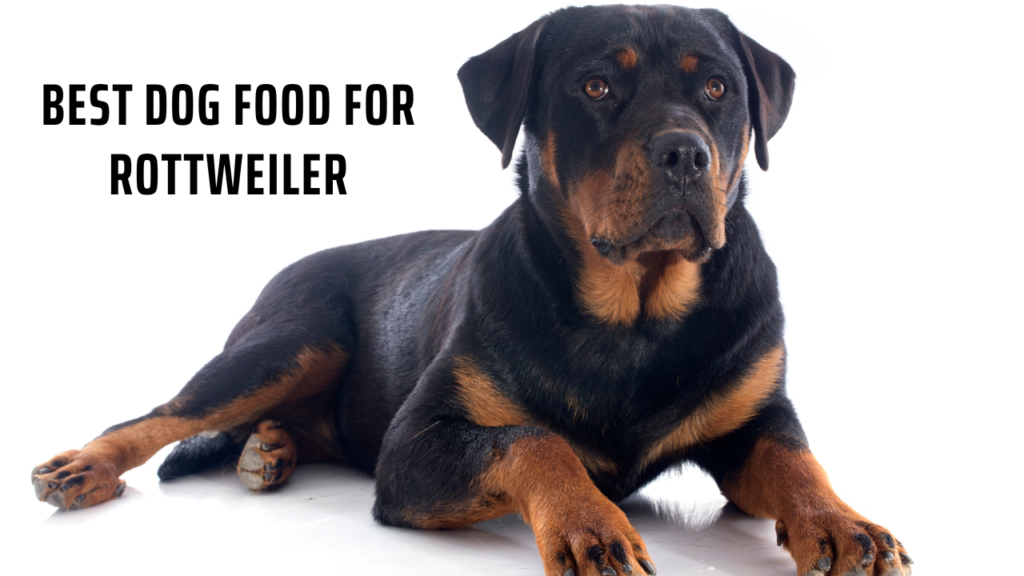
Quick answer: The best dog food for a Rottweiler is a complete and balanced diet that matches their life stage, body condition and health. For healthy adults, Hill’s Science Diet Adult Large Breed and Purina Pro Plan Large Breed are practical options to compare. In Australia, Royal Canin Rottweiler Adult is another option for dogs over 18 months. Growing puppies need food suitable for large-breed growth rather than an adult-maintenance diet.
A food does not need a Rottweiler on the bag to be appropriate. The important questions are whether it meets your dog’s nutritional needs, how much energy it supplies, and whether you can feed it consistently within your budget.
How we selected these options: This is a research-based buying guide using official product information and veterinary nutrition resources. We have not conducted hands-on product testing or feeding trials. The shortlist compares documented features and practical limitations; it does not establish that one food produces better health outcomes than another. Product details were checked on 4 November 2026. Always check the current packaging.
Best Dog Food for Rottweilers: Options to Compare
Start with your dog’s life stage. An adult food and a puppy food serve different purposes, even when both are sold by the same manufacturer. These are options to compare rather than a universal ranking.
United States shortlist
| Exact product | Intended use | Published energy | Main consideration |
|---|---|---|---|
| Hill’s Science Diet Adult Large Breed Chicken & Barley Recipe | Adult maintenance | 3,675 kcal/kg; 365 kcal/cup | The manufacturer publishes an AAFCO feeding-test statement for adult maintenance. It is not a puppy growth food. |
| Purina Pro Plan Large Breed Chicken & Rice Formula | Adult maintenance | 3,823 kcal/kg; 407 kcal/cup | The linked manufacturer label substantiates adult maintenance through AAFCO feeding tests. Do not confuse it with the Shredded Blend or puppy formula. |
| Hill’s Science Diet Puppy Large Breed Chicken & Brown Rice Recipe | Large-breed puppy growth | 3,591 kcal/kg; 387 kcal/cup | The manufacturer identifies it for large-breed puppies up to 18 months. Review transition timing with your veterinarian. |
Australian shortlist
| Australian product | Intended use | Published energy | Main consideration |
|---|---|---|---|
| Royal Canin Rottweiler Adult | Adult Rottweilers over 18 months | Not stated in the accessible page text | A breed-specific option. Request current calorie and nutritional-adequacy information if it is missing from your bag. |
| Hill’s Science Diet Adult Large Breed Chicken & Barley Recipe | Large-breed adult feeding | 3,675 kcal/kg; 365 kcal/cup | Use the Australian pack’s suitability and feeding directions, including its age and size guidance. |
| Purina Pro Plan Adult Large Breed Chicken Dry Dog Food | Large-breed adult feeding | 3.8 kcal/g, equivalent to 3,800 kcal/kg | The Australian recipe is a separate product from the US Chicken & Rice formula. Confirm the adequacy statement on the current pack. |
| Hill’s Science Diet Puppy Large Breed Chicken & Brown Rice Recipe | Large-breed puppy growth | 3,628 kcal/kg; 391 kcal/cup | The Australian page lists different energy values from the US page. Do not transfer a US cup allowance to this product. |
How to choose between them: For an adult eating a routine maintenance diet, compare the first two US options or the adult options listed for Australia. For a puppy, start with the growth option. If your dog already does well on an appropriate complete diet, a new “best food” list is not, by itself, a reason to switch.
Royal Canin’s breed-specific approach may appeal to owners seeking that format, but the breed name does not prove it is better for every Rottweiler. Our Royal Canin label-reading guide explains how to compare individual formulas.
Australian owners considering local alternatives can also use our Black Hawk range guide and ADVANCE formula guide. These are starting points for checking exact recipes rather than recommendations for every product in either range.
What Is the Best Food for a Rottweiler Puppy?
Choose a complete growth diet suitable for large-breed puppies. Confirm this through the nutritional-adequacy statement and manufacturer guidance, including any adult-size exclusions. An adult-maintenance food is not an appropriate substitute simply because your puppy already looks big.
The goal is steady growth while maintaining an appropriate body condition. Feeding extra food to make a puppy larger, or adding calcium to a balanced growth diet, can create problems. The RSPCA’s puppy-feeding guidance warns against overfeeding and advises against calcium supplements unless a veterinarian directs their use.
When feeding a Rottweiler puppy:
- Use your puppy’s age, growth trend and expected adult size when interpreting the feeding chart.
- Divide the daily ration into scheduled meals. Young puppies commonly need three or four meals, with frequency adjusted as they grow.
- Keep extras limited so they do not displace the balanced growth food.
- Review food choice and portions at veterinary growth checks.
Our puppy feeding schedule by age and weight explains how meal timing differs from portion size.
There is no single birthday on which every Rottweiler must move to adult food. Growth, expected size, the chosen product and your veterinarian’s assessment should guide the change. Do not keep increasing portions just because the puppy finishes every meal.
What Should You Look for on a Rottweiler Food Label?
1. A nutritional-adequacy statement for the right life stage
The FDA explains that complete and balanced foods are intended to supply a pet’s nutritional needs as the sole diet when used appropriately. Treats and toppers may not meet that standard.
On US products, check whether adequacy is substantiated through an AAFCO nutrient profile or feeding tests, and which life stage the statement covers. AAFCO establishes nutritional frameworks; it does not approve individual brands.
On Australian products, check the local pack and ask which nutritional standard and life stage the exact recipe meets.
2. Calories and a usable feeding guide
Calories connect the food to the portion you serve. A cup of one kibble can contain substantially different energy from a cup of another. Look for kcal/kg and, where supplied, kcal/cup, kcal/can or kcal/pack.
If calorie information is unavailable, ask the manufacturer before trying to calculate a precise ration. Also confirm whether a feeding chart refers to current weight or expected adult weight.
3. Formulation expertise and quality control
The WSAVA food-selection guide recommends asking who formulates the food, what nutritional expertise they have, how the finished product is checked, and what research supports it.
These questions provide more useful information than a fashionable ingredient claim alone.
4. The whole diet, rather than a protein percentage alone
There is no universal protein-and-fat range that identifies the best food for every Rottweiler. Life stage, calorie intake, medical needs and the full nutrient profile matter.
Avoid directly comparing a wet food’s printed protein percentage with a kibble’s percentage without accounting for moisture.
Tufts veterinary nutrition guidance explains why ingredient lists alone cannot establish a food’s nutritional quality. Corn, wheat or by-products do not automatically make a complete diet unsuitable. Likewise, “meat first,” “natural” or a high price does not establish that a food is best for your dog.
How Much Should a Rottweiler Eat Each Day?
Use the exact product’s feeding guide as a starting point, then adjust with your veterinary team according to body condition, weight trend, activity, life stage and health.
A fixed instruction such as “feed every adult Rottweiler three to five cups” ignores differences between dogs and foods.
Weighing food in grams helps you serve a consistent amount. When working from a veterinarian-agreed calorie target, use these calculations:
Food calories available = total daily calorie target − calories from approved extras
Grams per day = food calories available ÷ kcal per gram
Kcal per gram = kcal per kilogram ÷ 1,000
A worked example, not a feeding prescription
Suppose a veterinarian sets a total target of 1,600 kcal/day for an individual dog, with 100 kcal allocated to approved treats and extras. That leaves 1,500 kcal for the main food.
Using a food containing 3,675 kcal/kg:
1,500 ÷ 3.675 = approximately 408 g/day
Divide that ration into the meal schedule recommended for the dog. The 1,600 kcal target is illustrative; it is not a recommendation for every Rottweiler.
Check body condition as well as body weight
The WSAVA body-condition chart describes ideal adult condition as ribs that can be felt without excess fat, a visible waist from above and an abdominal tuck from the side.
Ask your veterinarian to assess both fat cover and muscle condition.
Record weight, measured intake and changes in appetite. For a growing puppy, use veterinary growth checks rather than an adult portion calculation.
Compare daily cost, not just bag price
Daily cost = bag price ÷ bag weight in grams × grams fed daily
For example, a hypothetical AUD $120 bag weighing 15 kg costs AUD $0.008 per gram. At a hypothetical 400 g/day ration, that is AUD $3.20/day.
These are example figures, not a current retailer quote or a suggested ration. Use current USD prices for US purchases and AUD prices for Australian purchases.
Choosing Food for Weight, Digestion and Joint Concerns
If your Rottweiler is gaining excess weight
Count everything offered: meals, chews, training treats, toppers and food used to give medication.
Share that record with your veterinarian before making large reductions. The appropriate solution may involve a different portion, a weight-management food, or investigation of a health issue.
If your Rottweiler is underweight or losing weight
Arrange a veterinary assessment for unexplained weight loss, even when appetite seems normal.
Avoid trying to “bulk up” a Rottweiler with fatty scraps, oils or large amounts of meat. Once the cause and target condition are established, your veterinarian can help choose an appropriate diet and gradual adjustment.
If your Rottweiler has a sensitive stomach or itchy skin
Repeated vomiting, diarrhea, itching or ear problems deserve assessment rather than repeated food changes.
“Sensitive,” “salmon” and “single protein” on a retail bag do not establish that the food will diagnose or treat an allergy. If your veterinarian prescribes a diet trial, ask which treats, chews and flavored medicines are permitted.
If your Rottweiler has stiffness or joint pain
Do not assume a food listing glucosamine, chondroitin or fish oil will prevent or treat joint disease. Ingredient presence does not establish a therapeutic dose or a clinical benefit for that product.
Have pain and mobility changes assessed, and discuss body condition and any recommended dietary treatment with your veterinarian.
Older Rottweilers also need individual assessment. Age alone does not justify a blanket reduction in protein or a fixed percentage cut in calories.
Is Grain-Free Food Better for Rottweilers?
Grain-free is not a breed requirement or proof of better nutrition.
The FDA’s diet-associated dilated cardiomyopathy investigation describes a complex potential association involving certain diets. Reports alone do not prove that a particular product causes disease, or that every grain-free diet has the same risk.
Discuss the exact formula with your veterinarian if you are considering an exclusion diet. Do not select food solely by whether it contains grains.
Our ORIJEN formula and label guide offers a framework for checking individual recipes when comparing premium alternatives.
Wet, Dry, Fresh or Homemade: Which Format Fits?
Choose nutritional suitability first, then consider storage, serving practicalities, your dog’s preferences and cost.
A complete wet food can be a main meal; a product intended only as a topper cannot automatically replace one.
| Food format | What to consider |
|---|---|
| Dry food | Practical to weigh and store. Follow the bag’s storage instructions and keep the packaging and lot details. |
| Wet food | A softer option with more moisture. Follow refrigeration and use-after-opening instructions. |
| Fresh cooked food | Check nutritional adequacy, the intended life stage, cold-chain requirements and the total daily serving. |
| Mixed feeding | Count calories from both foods. Adding wet food to a full dry-food ration increases total intake. |
If you are comparing Australian rolls, cooked meals or air-dried products, our Prime100 range guide explains why the exact recipe and intended use matter.
Ordinary kibble should not replace dental care. The Veterinary Oral Health Council recommends regular tooth brushing; ask your veterinarian about a suitable dental routine and evidence-supported dental products.
What about raw food and homemade meals?
The FDA warns that raw pet food can carry harmful bacteria, creating risks for pets and people. A raw label also does not establish nutritional completeness or suitability for large-breed growth.
For a home-prepared main diet, ask your veterinarian for referral to an appropriately qualified veterinary nutrition specialist.
UC Davis research on home-prepared recipes found widespread nutritional deficiencies. A mixture of meat, rice and vegetables, or rotating several internet recipes, should not be assumed complete and balanced.
Treats and Toppers: Keep the Main Diet in Balance
WSAVA’s treating guidance recommends keeping treats below 10% of daily calories.
Your veterinarian may recommend tighter limits for puppies or dogs on therapeutic diets. The allowance is a ceiling rather than a target to fill.
Reserve some of the measured daily kibble for training rewards.
If your veterinarian agrees that human-food extras fit the diet, our guides to plain cooked eggs, serving carrots safely and plain cooked rice explain preparation and limitations.
These foods do not make an incomplete meal nutritionally balanced.
Avoid unsafe extras such as grapes, raisins, onions, chocolate and xylitol-containing products. Our grape and raisin safety guide explains why suspected ingestion needs prompt veterinary advice, even before symptoms appear.
How to Change Your Rottweiler’s Food
For a healthy dog making a routine change, follow the new food’s transition instructions. The manufacturers listed here generally recommend introducing increasing amounts over approximately seven to ten days.
Dogs with gastrointestinal disease, a prescribed diet or an adverse reaction may need a different veterinary plan.
During a transition:
- Monitor appetite, stools and comfort.
- Account for the energy from both foods.
- Avoid adding several unfamiliar treats or supplements at the same time.
- Keep fresh drinking water available.
Before purchasing, check the exact recipe, country, package condition, lot code and best-before date.
US owners can consult the FDA animal-food recall notices. Australian owners should check current manufacturer and retailer notices for the local product. A brand’s reputation does not replace checking a specific batch.
When feeding symptoms need urgent care
Repeated unproductive retching, a swollen abdomen, marked distress, weakness or collapse require immediate veterinary attention.
These can be signs of gastric dilatation-volvulus, a life-threatening emergency described by the American College of Veterinary Surgeons. Do not wait for a diet change to help.
Seek prompt veterinary advice for repeated vomiting, bloody diarrhea, inability to keep water down, suspected poisoning, persistent appetite loss or unexplained weight loss.
Frequently Asked Questions
Is chicken or salmon better for a Rottweiler?
Neither is automatically best for the breed. Compare complete formulas suitable for your dog’s life stage and needs. A salmon label does not make a food appropriate for every itchy dog, and a chicken recipe is not unsuitable simply because chicken is a common ingredient.
Can I mix adult food with my Rottweiler puppy’s food to save money?
Do not use adult-maintenance food to stretch a growing puppy’s balanced ration without veterinary guidance. It changes the overall nutrient intake. Ask your veterinary team to help find an affordable complete food suitable for large-breed growth.
Does neutering mean my Rottweiler puppy should switch to adult food?
No. Neutering and completion of growth are separate considerations. Your veterinary team can review calorie intake after surgery while ensuring the diet remains suitable for the puppy’s growth stage.
Disclaimer: This article provides general educational information and is not a substitute for individualized veterinary advice. Consult your veterinarian about your dog’s diet, symptoms or health concerns, especially for puppies, pregnant or nursing dogs, and dogs with medical conditions.
Leave a Reply