Budget-Friendly Dog Meal Planning: The Complete 2026 Guide to Feeding Your Dog Well for Less
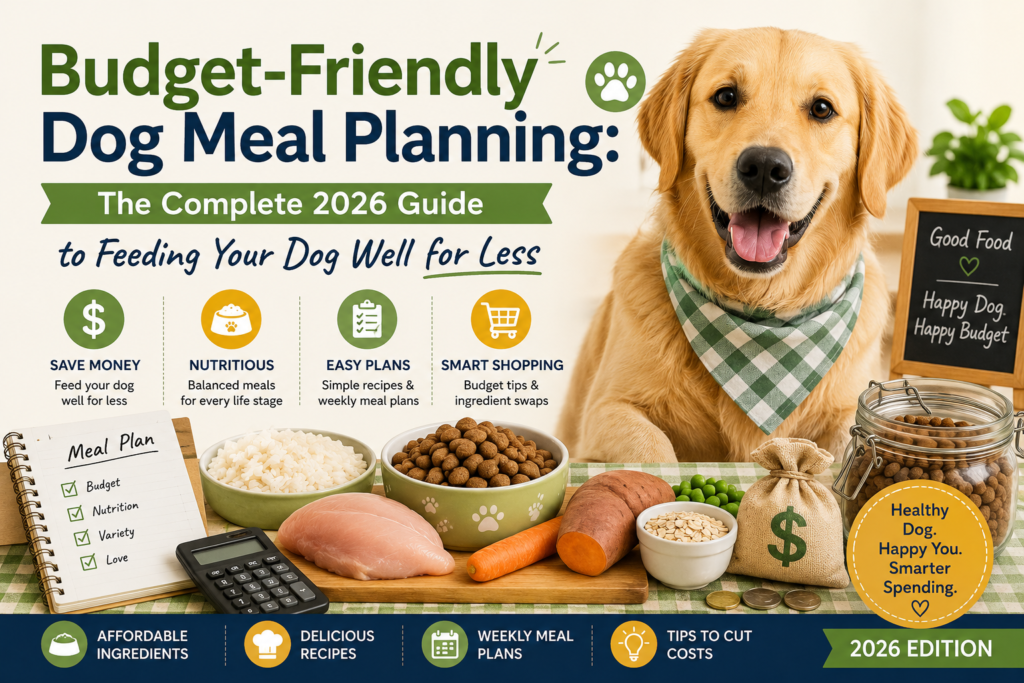
Quick Answer: Budget-friendly dog meal planning means combining a quality mid-range kibble base with affordable whole-food toppers — chicken, eggs, rice, sweet potato, and frozen vegetables — bought in bulk and prepped in batches. A 25–30 lb dog can be fed a nutritious, balanced diet for $1.50 to $3.00 per day. The key is planning ahead, not buying cheap fillers.
Why Most Dog Owners Overspend on Food
Most pet owners buy dog food the same way they buy petrol — reactively, when the tank is empty. They grab whatever is available, often paying a premium for convenience-sized bags or falling for clever marketing on packaging that promises “superfood” formulas.
The result? Families spend far more than necessary without getting meaningfully better nutrition for their dog.
The truth is that planning just one hour per week can cut your dog food costs by 30–50% while actually improving the quality of what your dog eats. The most expensive bag on the shelf is not automatically the healthiest — and the cheapest bag is not always the worst. The difference lies in knowing what you’re buying and why.
This guide gives you that knowledge.
The True Cost of Feeding a Dog in 2026
Before you can plan a budget, you need to understand what it actually costs to feed a dog properly. Here’s a realistic breakdown based on current pricing:
| Feeding Approach | Estimated Monthly Cost (25–30 lb dog) | Nutritional Quality | Time Required |
|---|---|---|---|
| Premium kibble (no planning) | $90–$150 | High but inconsistent | Very low |
| Cheap kibble only | $25–$45 | Often poor | Very low |
| Mid-range kibble + whole food toppers | $45–$75 | High | Low (30 min/week) |
| Fully home-cooked, vet-balanced | $55–$90 | Very high | Medium (1–2 hrs/week) |
| Kibble + bulk-bought proteins | $35–$60 | High | Low once set up |
| Fresh food subscription (e.g. Ollie) | $60–$120 | Very high | Minimal |
The sweet spot for most families — maximum nutrition at minimum cost — is mid-range kibble combined with affordable whole food toppers, bought in bulk and prepped in batches.
Budget Meal Planning vs. Buying Cheap Kibble: The Critical Difference
This is the most important concept in this entire guide: budget meal planning is not the same as buying the cheapest food.
Cheap kibble — the bottom-shelf bags filled with corn syrup, artificial dyes, meat by-product meal, and excessive grain fillers — saves money short-term but costs far more over time through:
- Increased vet bills from nutritional deficiencies
- Poor coat, skin, and immune function requiring supplements
- Digestive issues and increased stool volume
- Obesity from fillers that don’t satisfy hunger
A planned budget means spending strategically on the ingredients that give your dog the most nutritional value per dollar — quality proteins, digestible carbohydrates, and fresh vegetables — while cutting costs everywhere else.
As the American Kennel Club notes, even small changes to a dog’s diet can affect nutritional balance. Planning removes the guesswork and the waste.
Understanding What Your Dog Actually Needs Nutritionally
Before adding any ingredient to your dog’s bowl, it helps to understand what they actually need. According to PetMD, the Association of American Feed Control Officials (AAFCO) identifies six essential nutrient categories that all dog diets must provide:
| Nutrient | Role | Affordable Sources |
|---|---|---|
| Protein | Muscle maintenance, immune function, enzyme production | Chicken, eggs, canned fish, turkey mince |
| Fats | Energy, skin & coat health, fat-soluble vitamin absorption | Chicken skin (in moderation), fish oil, eggs |
| Carbohydrates | Energy, digestive fibre | Brown rice, white rice, oats, sweet potato |
| Vitamins | Immune function, metabolism, cell health | Sweet potato, carrots, eggs, leafy greens |
| Minerals | Bone health, fluid balance, nerve function | Eggshell powder (calcium), fish, meat |
| Water | Every bodily function | Always available fresh; boosted by wet toppers |
Important caveat: PetMD and the AKC both strongly recommend consulting a veterinarian or board-certified veterinary nutritionist before switching to a fully home-cooked diet. Research from the University of California, Davis found that 95% of 200 analyzed home-cooked dog food recipes lacked at least one essential nutrient. This guide focuses on supplementing a kibble base — not replacing it — to reduce risk while cutting cost.
The Best Affordable Ingredients for Dogs
These are the most cost-effective, nutritionally valuable ingredients you can use to supplement your dog’s kibble base or build budget home-cooked meals:
🍗 Chicken (Thighs, Drumsticks, Whole)
Chicken is the gold standard of budget dog food. Bone-in thighs and drumsticks are particularly affordable and can be purchased in large family packs. Always remove all bones before serving — cooked bones splinter and can cause serious internal injuries.
Cost: Approximately $1.50–$2.50/lb in bulk packs.
🥚 Eggs
One of the most nutritionally complete foods available at any price. A single egg contains complete protein, healthy fats, vitamins A, D, E, B12, riboflavin, and biotin. Scrambled, boiled, or served raw (yolk only, for dogs with sensitive stomachs) — eggs are an outstanding budget ingredient.
Cost: Approximately $0.20–$0.35 per egg.
🍚 White Rice or Brown Rice
An easily digestible carbohydrate that pairs perfectly with protein. White rice is gentler on sensitive stomachs; brown rice provides more fibre. Both are extremely affordable and have a long shelf life when bought in bulk.
Cost: Approximately $0.05–$0.10 per serving.
🌾 Plain Rolled Oats
A great alternative carbohydrate source. Rich in fibre and soluble beta-glucan, which supports digestive health. Always cook before serving and use plain, unflavored oats — never instant or flavored varieties.
Cost: One of the cheapest foods available per serving.
🐟 Canned Fish (Sardines or Tuna in Water)
An outstanding source of omega-3 fatty acids (EPA and DHA) that support coat health, joint function, and inflammation reduction. Use sardines in water as the first choice — they are lower in mercury than tuna. Limit to 2–3 times per week.
Cost: Approximately $0.80–$1.50 per can.
🍠 Sweet Potatoes
Naturally rich in beta-carotene, vitamin C, potassium, and fibre. Dogs tend to love the flavour. Steam or boil before serving — never raw. A 5 lb bag of sweet potatoes goes a long way.
Cost: Approximately $0.50–$1.00/lb.
🥕 Carrots
One of the best low-calorie dog snacks. Crunchy, sweet, and packed with beta-carotene and fibre. Can be served raw or cooked. Great for dogs that love to chew. For more on using carrots and other vegetables safely, see our guide on can dogs eat cucumbers and safe snack alternatives.
Cost: One of the cheapest vegetables available.
🥦 Frozen Mixed Vegetables
Frozen peas, green beans, carrots, and broccoli are nutritionally equivalent to fresh — and far cheaper. Plain, unseasoned frozen vegetables are safe, nutritious, and incredibly affordable. Always choose varieties with no added salt or sauce.
Cost: Approximately $0.80–$1.50 per 500g bag.
🦃 Turkey Mince
A leaner, slightly more affordable alternative to beef. High in protein and low in fat, making it excellent for weight management. Buy in bulk and freeze in weekly portions.
Cost: Often $2.00–$3.50/lb.
Foods to Avoid Even When Budget Is Tight
Some foods seem like cheap options but are dangerous for dogs. Never use these as budget substitutes, no matter how tight your finances:
| Food | Why to Avoid |
|---|---|
| Onions and garlic | Toxic to dogs — causes red blood cell destruction |
| Grapes and raisins | Can cause sudden kidney failure, even in small amounts |
| Chocolate | Contains theobromine — toxic to dogs |
| Xylitol (sweetener) | Causes severe hypoglycemia and liver damage |
| Macadamia nuts | Toxic — causes weakness, vomiting, tremors |
| Avocado | Contains persin — toxic to dogs |
| Cooked bones | Splinter and can cause intestinal perforation |
| Raw dough | Expands in the stomach and produces alcohol |
| Salty processed meats | Excess sodium can cause toxicosis |
For a complete guide on which human foods are safe and which are dangerous, browse our Can Dogs Eat? category. Individual guides worth reading include:
- Can Dogs Eat Tomatoes? — what’s safe vs. toxic
- Can Dogs Eat Bread? — full safety guide
- Can Dogs Eat Crab Apples? — seasonal hazard explained
- Can Dogs Eat Pumpkin Seeds? — benefits, risks, portions
How to Structure a Budget Dog Meal Plan
A well-structured budget meal plan uses a three-layer system:
Layer 1: A Quality Kibble Base (60–70% of the diet)
Choose a mid-range kibble with meat as the first ingredient, an AAFCO nutritional adequacy statement, and no artificial colours or excessive fillers. You don’t need to spend top dollar — brands like Purina One, Diamond Naturals, and Royal Canin’s mid-range lines offer solid nutrition at reasonable prices.
This base ensures your dog gets consistent, balanced macronutrients and micronutrients every day without the complexity of fully home-cooked meals.
Layer 2: Whole Food Protein Toppers (20–25% of the diet)
Add affordable whole food proteins — boiled chicken, scrambled egg, or canned sardines — on top of the kibble base 4–5 times per week. This dramatically improves palatability, adds real nutrition, and makes expensive branded toppers unnecessary.
Layer 3: Vegetable and Carbohydrate Mix-ins (10–15% of the diet)
Rotate in cooked vegetables and carbohydrates — sweet potato, brown rice, frozen peas, carrots — a few times a week. These add fibre, antioxidants, and variety at very low cost.
This layered approach gives you complete, varied, high-quality nutrition at a fraction of the cost of premium commercial diets — while keeping the meal balanced through the kibble base.
Sample 7-Day Budget Meal Plan (by Dog Size)
The following plans use the layered system above. Adjust portions according to your dog’s weight and activity level. For detailed feeding amounts, consult our 7-Day Balanced Dog Meal Plan guide and the PetMD dog feeding chart.
For a Small Dog (10–20 lbs, e.g. Shih Tzu, Dachshund)
| Day | Morning | Evening | Est. Daily Cost |
|---|---|---|---|
| Monday | ¼ cup kibble + 1 tbsp boiled chicken | ¼ cup kibble + steamed carrot pieces | $0.70 |
| Tuesday | ½ scrambled egg + 2 tbsp rice | ¼ cup kibble + 1 tbsp sweet potato mash | $0.65 |
| Wednesday | ¼ cup kibble + 1 tsp sardine in water | ¼ cup kibble + frozen peas (thawed) | $0.80 |
| Thursday | Boiled chicken + 2 tbsp oats | ¼ cup kibble + grated carrot | $0.70 |
| Friday | ¼ cup kibble + scrambled egg (half) | ¼ cup kibble + green beans | $0.65 |
| Saturday | Chicken + sweet potato + rice | ¼ cup kibble + tuna (½ tsp) | $0.85 |
| Sunday | ¼ cup kibble + egg yolk drizzle | Turkey mince + rice + peas | $0.75 |
| Weekly Total | ~$5.10 |
For a Medium Dog (25–40 lbs, e.g. Beagle, Cocker Spaniel, Bulldog)
| Day | Morning | Evening | Est. Daily Cost |
|---|---|---|---|
| Monday | ¾ cup kibble + 2 tbsp boiled chicken | ¾ cup kibble + ¼ cup steamed carrots | $1.70 |
| Tuesday | 1 scrambled egg + ¼ cup rice | ¾ cup kibble + sweet potato (2 tbsp) | $1.60 |
| Wednesday | ¾ cup kibble + sardine in water (1 tbsp) | ¾ cup kibble + frozen mixed veg | $1.90 |
| Thursday | Boiled chicken (60g) + ¼ cup oats | ¾ cup kibble + grated carrot | $1.70 |
| Friday | ¾ cup kibble + 1 egg | ¾ cup kibble + green beans | $1.65 |
| Saturday | Chicken + sweet potato + rice | ¾ cup kibble + tuna (1 tsp) | $2.00 |
| Sunday | ¾ cup kibble + egg yolk | Turkey mince (60g) + rice + peas | $1.75 |
| Weekly Total | ~$12.30 |
For a Large Dog (50–80 lbs, e.g. Labrador, German Shepherd)
| Day | Morning | Evening | Est. Daily Cost |
|---|---|---|---|
| Monday | 1.5 cups kibble + 80g boiled chicken | 1.5 cups kibble + ½ cup steamed carrots | $2.90 |
| Tuesday | 2 scrambled eggs + ½ cup rice | 1.5 cups kibble + sweet potato | $2.70 |
| Wednesday | 1.5 cups kibble + sardines (full can) | 1.5 cups kibble + frozen veg (½ cup) | $3.10 |
| Thursday | Boiled chicken (120g) + ½ cup oats | 1.5 cups kibble + grated carrot | $2.80 |
| Friday | 1.5 cups kibble + 2 eggs | 1.5 cups kibble + green beans | $2.75 |
| Saturday | Chicken + sweet potato + brown rice | 1.5 cups kibble + tuna (1 tbsp) | $3.20 |
| Sunday | 1.5 cups kibble + egg yolk drizzle | Turkey mince (120g) + rice + peas | $2.90 |
| Weekly Total | ~$20.35 |
For German Shepherd-specific feeding advice and product recommendations, visit our dedicated guide: Best Dog Food for German Shepherds.
Batch Cooking: The Biggest Time and Money Saver
Batch cooking is the single most effective practice for budget dog meal planning. Instead of preparing food daily, you cook large quantities once or twice per week and store portions in the fridge or freezer.
How to Batch Cook Dog Food
Step 1: Plan the week Decide which proteins, carbohydrates, and vegetables you’ll use. Rotate proteins each batch (chicken this week, turkey next, fish the week after) to ensure variety.
Step 2: Cook in bulk
- Boil 1–2 kg of chicken thighs in a large pot (no salt, no seasoning)
- Cook a large pot of brown rice or oats separately
- Steam or roast a tray of sweet potato and carrots
Step 3: Cool completely before portioning Never seal warm food — it creates condensation that accelerates bacterial growth.
Step 4: Portion into daily servings Use reusable containers or zip-lock bags. Label with the date. Refrigerate what you’ll use within 3 days; freeze the rest.
Step 5: Storage timelines
- Refrigerator: 3–4 days maximum
- Freezer: Up to 2 months (after that, nutritional quality degrades)
As the AKC advises, store dog food in airtight containers away from direct sunlight to slow oxidation and preserve freshness.
Time Investment
One session of batch cooking typically takes 45–90 minutes and covers a full week’s worth of toppers and mix-ins. That’s less than 15 minutes per day — making it genuinely feasible even for busy families.
Bulk Buying Strategy: What to Buy and Where
Buying in bulk is the fastest way to reduce your per-meal cost. Here’s what to buy in large quantities and where to find the best prices:
What to Buy in Bulk
| Ingredient | Shelf Life | Storage Method | Where to Buy |
|---|---|---|---|
| Dry kibble (large bag) | 3–6 months (opened) | Airtight container, cool/dry | Pet supply stores, online |
| Chicken thighs/drumsticks | Up to 6 months frozen | Freeze in weekly portions | Supermarket family packs |
| Brown/white rice | 12+ months | Pantry in airtight container | Bulk food stores, supermarkets |
| Plain rolled oats | 12+ months | Pantry in airtight container | Supermarkets, bulk stores |
| Canned sardines/tuna | 2–5 years | Pantry | Supermarkets in multipacks |
| Frozen vegetables | 12 months | Freezer | Supermarkets in large bags |
| Sweet potatoes | 2–5 weeks (cool/dark) | Root vegetable storage | Supermarkets in 5 lb bags |
Where to Buy
- Supermarket family packs: Chicken, eggs, and frozen vegetables are cheapest in the largest size available. Always compare cost per 100g, not pack price.
- Warehouse stores (Costco, Sam’s Club, Aldi bulk): Excellent for rice, canned fish, frozen vegetables, and eggs. Membership pays for itself quickly with multiple pets.
- Online pet retailers (Chewy, PetBarn): Large bags of kibble are almost always cheaper online. Sign up for auto-delivery subscriptions for an additional 10–15% discount.
- Seasonal produce markets: Buy sweet potatoes, carrots, and squash in bulk during autumn when they’re cheapest and freeze or store for winter.
Smart Supplementing on a Budget
Even a well-planned kibble-plus-toppers diet may have nutritional gaps, particularly in omega-3 fatty acids, calcium, and certain B vitamins. These affordable supplements help fill those gaps without breaking the budget:
1. Fish Oil (Omega-3)
The most valuable supplement for most dogs. Supports coat quality, joint health, brain function, and inflammation management. Liquid fish oil is more cost-effective than capsules — add directly to food.
Budget option: Look for human-grade wild salmon oil or sardine oil. A 500ml bottle typically lasts 1–2 months for a medium dog.
2. Eggshell Powder (Calcium)
If you’re feeding home-cooked meals as a significant portion of your dog’s diet, calcium supplementation is critical. Dried and powdered eggshells are a completely free, natural calcium source — simply bake eggshells at 180°C for 10 minutes, then grind to a fine powder. Add ½ tsp per 500g of home-cooked food.
3. A Mid-Range Multivitamin
A daily broad-spectrum multivitamin can act as nutritional insurance, particularly useful when rotating ingredients and feeding partly home-cooked. Look for products formulated specifically for dogs, not human multivitamins (which can contain unsafe doses of certain vitamins).
Important: As PetMD notes, simply adding a generic multivitamin is not sufficient on its own. Use supplements as insurance, not a substitute for balanced ingredient selection.
4. Plain Pumpkin (Digestive Support)
A small amount of plain canned pumpkin (not pie filling) added to meals is a cheap, effective way to support digestive health. Rich in fibre and water content, it helps with both constipation and loose stool. A single can goes a long way.
How to Read Dog Food Labels to Avoid Wasting Money
Choosing the right kibble base is one of the most important budget decisions you’ll make. A better base means less supplementing, fewer health issues, and less wasted money on food your dog doesn’t digest efficiently.
Here’s what to look for and avoid:
Green Flags (Buy These)
- Meat as the first ingredient (e.g. “Chicken,” “Turkey,” “Salmon” — not “Chicken meal” as the only protein)
- AAFCO nutritional adequacy statement — confirms the food is “complete and balanced” for your dog’s life stage
- Named fat sources (e.g. “Chicken fat,” “Salmon oil”)
- Limited ingredient list — fewer ingredients often means less processed
- No artificial colours or preservatives (avoid BHA, BHT, ethoxyquin)
Red Flags (Avoid These)
- “Meat by-products” as the first or second ingredient
- Corn syrup or any added sugar
- “Animal digest” — an undefined, heavily processed ingredient
- Multiple grains in the first five ingredients — often used to inflate protein percentages
- Artificial dyes (Red 40, Yellow 5/6, Blue 2) — no nutritional benefit, potentially harmful
For help choosing the right food for specific breeds, see our guides on best dog food for German Shepherds, best dog food for senior dogs, and best dog food for joint support.
Budget Meal Planning for Special Cases
Senior Dogs
Older dogs often need fewer calories but more joint-supporting nutrients like omega-3s and glucosamine. A mid-range senior kibble combined with oily fish toppers (sardines twice weekly) is an excellent and affordable approach. For a complete guide, see Best Dog Food for Senior Dogs.
Puppies
Puppies need higher protein, more calcium, and specific DHA ratios for brain development. Puppy-specific kibble is essential as the base — don’t cut costs here by using adult food. Supplement with boiled chicken and mashed sweet potato for affordable variety.
Overweight Dogs
Budget meals for overweight dogs should prioritise low-calorie, high-volume ingredients — boiled chicken breast (no skin), green beans, carrots, and cucumber slices. Reduce the kibble portion and fill the volume with cooked vegetables. See our can dogs eat cucumbers guide for low-calorie snack ideas.
Dogs with Sensitive Stomachs
Stick to a short ingredient list: one protein (boiled chicken or turkey), one carbohydrate (white rice), and one vegetable (steamed carrot or pumpkin). Introduce new foods one at a time, over 5–7 days. For gut health support, see our guide on how to improve your dog’s gut health naturally.
Large Breed Dogs
Large breeds have higher food volume requirements, so cost savings from bulk buying are amplified. A 15–20 kg bag of mid-range kibble combined with weekly chicken batch cooking is the most economical strategy. See our best dog food for joint support for additional large-breed considerations.
Common Budget Meal Planning Mistakes
These are the most expensive errors dog owners make when trying to cut costs:
1. Buying the Cheapest Kibble Without Reading the Label
Bottom-shelf kibble with corn syrup, artificial colours, and undefined by-products creates digestive issues and nutritional deficiencies that lead to vet bills far exceeding the savings.
2. Cutting Protein to Save Money
Protein is the most critical macronutrient for dogs. Reducing meat increases carbohydrate content, leads to muscle loss over time, and creates a dog that is always hungry and less satisfied — often causing owners to feed more total volume, not less.
3. Forgetting Calcium in Home-Cooked Meals
One of the most common — and dangerous — mistakes in home-cooked diets. Without bone meal, eggshell powder, or a calcium supplement, purely muscle-meat-based diets lead to calcium deficiency and bone problems over months to years.
4. Not Planning Portions
Eyeballing portion sizes leads to overfeeding, which increases food costs and causes weight gain. Use a kitchen scale and follow feeding guides based on your dog’s ideal weight — not current weight, if they’re overweight.
5. Ignoring Shelf Life and Wasting Food
Buying cheap in bulk only saves money if you actually use what you buy before it expires. Track shelf lives, rotate stock correctly, and freeze proteins immediately after purchasing.
6. Making Sudden Diet Changes
Switching foods too quickly causes digestive upset. Transition over 7–10 days by gradually increasing the new food while decreasing the old. A dog with an upset stomach means wasted food and potential vet costs.
Monthly Budget Breakdown by Dog Size
Here is a realistic, detailed monthly cost estimate for the kibble-plus-toppers approach:
Small Dog (10–20 lbs)
| Item | Quantity/Month | Estimated Cost |
|---|---|---|
| Mid-range kibble (small bag) | 4–5 kg | $18–$25 |
| Chicken thighs | 500g | $3–$5 |
| Eggs (carton of 12) | 1 carton | $4–$6 |
| Canned sardines | 4–6 cans | $4–$7 |
| Rice/oats | Bulk share | $1–$2 |
| Frozen vegetables | 500g bag | $2–$3 |
| Fish oil supplement | Monthly share | $3–$5 |
| Monthly Total | ~$35–$53 |
Medium Dog (25–40 lbs)
| Item | Quantity/Month | Estimated Cost |
|---|---|---|
| Mid-range kibble (large bag) | 8–10 kg | $30–$45 |
| Chicken thighs | 1.5 kg | $5–$9 |
| Eggs (carton of 12) | 2 cartons | $8–$12 |
| Canned sardines | 8 cans | $8–$12 |
| Rice/oats | Bulk share | $2–$3 |
| Frozen vegetables | 1 kg bag | $3–$4 |
| Fish oil supplement | Monthly share | $4–$6 |
| Monthly Total | ~$60–$91 |
Large Dog (50–80 lbs)
| Item | Quantity/Month | Estimated Cost |
|---|---|---|
| Mid-range kibble (large bag) | 15–18 kg | $50–$75 |
| Chicken thighs | 3 kg | $9–$15 |
| Eggs (carton of 12) | 3 cartons | $12–$18 |
| Canned sardines | 10–12 cans | $10–$16 |
| Rice/oats | Bulk share | $3–$5 |
| Frozen vegetables | 1.5 kg | $4–$6 |
| Fish oil supplement | Monthly share | $5–$8 |
| Monthly Total | ~$93–$143 |
These figures represent genuine nutritional quality — not the minimum possible spend. You can reduce these further through more aggressive bulk buying, seasonal produce, and discount monitoring.
FAQs
For a fully home-cooked diet to be nutritionally complete, it requires vet-formulated recipes and specific supplements — which adds cost. The most cost-effective approach is using a quality mid-range kibble as a base and supplementing with affordable whole foods. Pure home cooking is rarely cheaper than planned kibble-plus-toppers.
Whole chicken — especially bone-in thighs and drumsticks purchased in family packs — consistently offers the lowest cost per gram of quality protein. Eggs are the second-best value. Always remove all cooked bones before serving.
Plain chicken and rice is a common short-term remedy for digestive upset, but it is nutritionally incomplete as a long-term sole diet. It lacks calcium, essential fatty acids, vitamins A, D, E, B12, and several minerals. Use it as one meal in rotation, not as the entire diet.
Mix kibble with cooked rice or steamed vegetables. This increases meal volume without meaningfully increasing cost or reducing nutrition, and leaves most dogs just as satisfied.
Yes — plain frozen vegetables with no added salt, sauce, or seasoning are completely safe and nutritious for dogs. Avoid any variety that includes onion or garlic, which are toxic.
Most families find that cooking once per week works well. One 60–90 minute session produces enough protein and vegetable toppers for 7 days. Some owners prefer twice-weekly smaller batches for variety.
Fish oil (omega-3) is the most universally useful. Calcium supplementation (via eggshell powder or bone meal) is critical if home-cooked food makes up more than 30–40% of the diet. A broad-spectrum dog multivitamin adds nutritional insurance. Always check with your vet before adding supplements.
A realistic target:
Small dog (under 20 lbs): $0.60–$1.00/day
Medium dog (25–40 lbs): $1.50–$2.50/day
Large dog (50–80 lbs): $2.50–$4.00/day
These figures reflect the kibble-plus-toppers approach with bulk buying.
Final Thoughts
Budget-friendly dog meal planning is not about feeding your dog less — it’s about feeding them smarter. With a quality mid-range kibble as the nutritional foundation, affordable whole foods as toppers, and batch cooking to eliminate waste, you can provide your dog with genuinely excellent nutrition at a fraction of what premium brands charge.
The pillars of this approach:
- ✅ Choose kibble with meat as the first ingredient and an AAFCO adequacy statement
- ✅ Supplement with chicken, eggs, sardines, sweet potato, and frozen vegetables
- ✅ Batch cook proteins and carbohydrates once a week
- ✅ Buy in bulk for everything with a long shelf life
- ✅ Use fish oil and eggshell powder as affordable nutritional insurance
- ✅ Always transition new foods slowly — over 7–10 days
- ✅ Consult your vet before making significant changes, especially for puppies, seniors, or dogs with health conditions
Done correctly, this approach consistently delivers better nutrition than expensive premium kibble — at a cost of $1.50 to $4.00 per day depending on your dog’s size.
Explore more resources on Healthy Dogs Meals:
- 📋 7-Day Balanced Dog Meal Plan — a complete week-by-week template
- 🐕 Best Dog Food for Senior Dogs — evidence-informed picks for older dogs
- 💪 Best Dog Food for Joint Support — for large and active breeds
- 🐾 Best Dog Food for German Shepherds — breed-specific recommendations
- 🌿 How to Improve Your Dog’s Gut Health Naturally — diet-based gut support
- 🇦🇺 Best Affordable Dog Food in Australia — value picks for Australian dog owners
- 🥒 Can Dogs Eat Cucumbers? — best low-calorie snack explained
- 📚 Dog Meal Plans Category — all our meal planning guides
Sources & References
- AKC — Homemade Dog Food: Choosing Balanced Ingredients
- AKC — Dog Meal Prep: How to Prepare Dog Food in Bulk
- PetMD — Dog Nutrition: Guide to Dog Food Nutrients
- PetMD — How to Make Sure Your Homemade Dog Food Delivers the Right Nutrients
- PetMD — Dog Feeding Chart: How Much Should I Feed My Dog?
- Dog Food Advisor — Best Budget-Friendly Dog Foods 2026
- Association of American Feed Control Officials (AAFCO)
Medical Disclaimer: The information on Healthy Dogs Meals is for educational purposes only and does not replace professional veterinary advice. Always consult your veterinarian before making significant changes to your dog’s diet, especially for puppies, senior dogs, or dogs with existing health conditions.
Affiliate Disclosure: Some links in this article may be affiliate links. If you make a purchase, we may earn a small commission at no extra cost to you. We only recommend products we genuinely believe in.