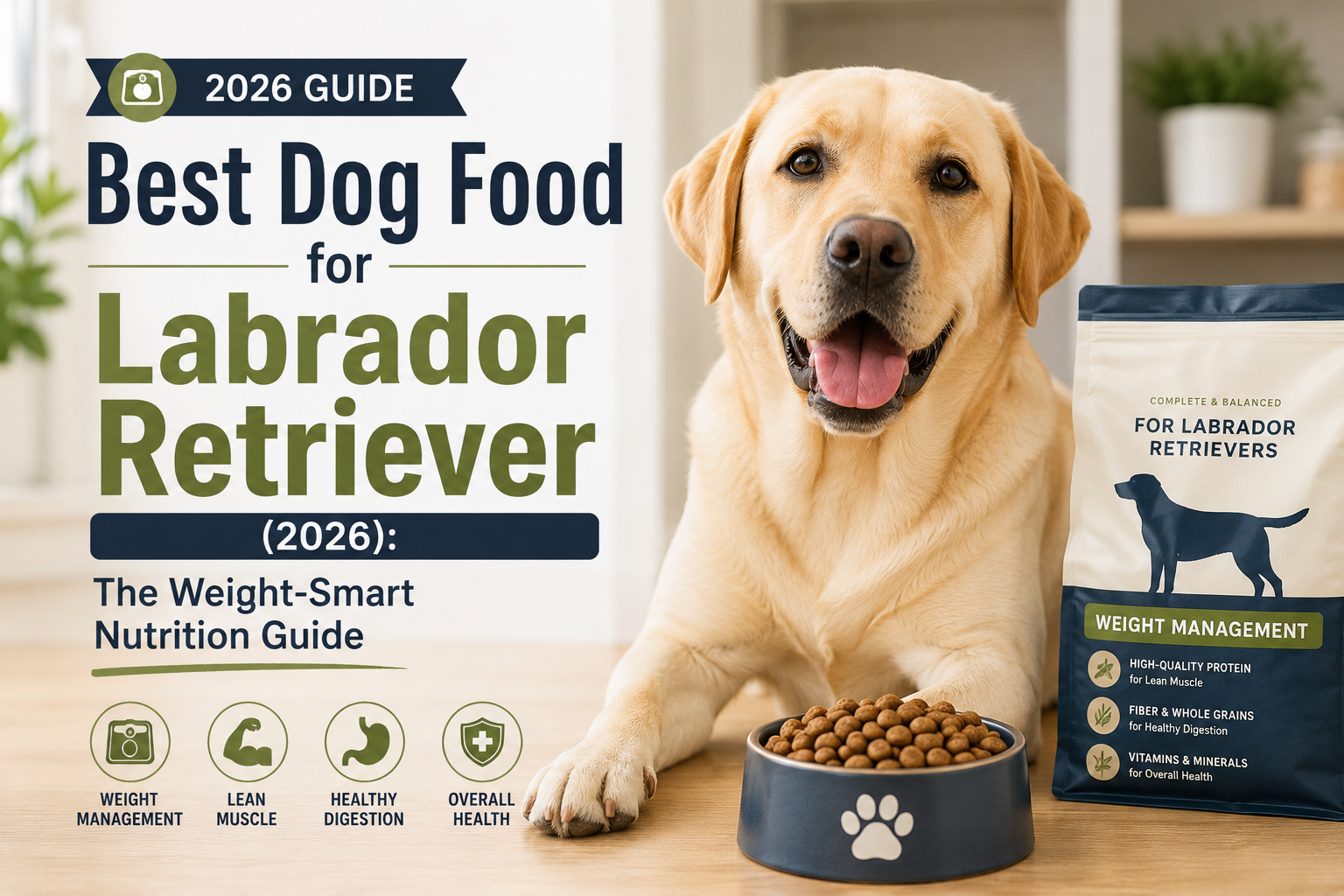
Quick Answer (AI Overview): The best dog food for a Labrador is a large-breed formula with named animal protein first (22–27% for adults), moderate fat (10–16%), joint-support nutrients (glucosamine, chondroitin, omega-3s), and tightly controlled calories — because Labradors are genetically prone to overeating and obesity. Puppies need a large-breed puppy formula with controlled calcium (~1–1.3%) to protect developing hips and elbows. Feed two measured meals daily, never free-feed, and keep your Lab lean: it’s the single most powerful health decision you can make for this breed.
Affiliate Disclosure: This post may contain affiliate links. If you purchase through these links, Healthy Dogs Meals may earn a small commission at no extra cost to you. We only recommend products we genuinely believe can help your dog. Read our full Affiliate Disclosure
Labradors are the world’s favourite family dog for good reason: endlessly affectionate, famously trainable, and enthusiastic about absolutely everything — especially food. And that last trait is precisely the problem. Ask any vet which breed they see battling the scales and the answer comes instantly. The bottomless Labrador appetite isn’t a character flaw or bad training; for many Labs, it’s written into their DNA.
That genetic reality shapes everything about feeding this breed. In this guide, we cover what makes the best dog food for Labrador retrievers different, the science behind their hunger, exact feeding charts for puppies through seniors, joint and coat nutrition, the always-hungry survival playbook, and the ingredients to avoid. It joins our breed series alongside the Best Dog Food for Golden Retriever and Best Dog Food for Beagle guides.
Why Labradors Have Unique Nutritional Needs
1. The POMC Gene: Why Your Lab Is Always Hungry
Research from the University of Cambridge identified a deletion in the POMC gene in a substantial proportion of Labradors (and most flat-coated retrievers). Dogs with this mutation experience weaker satiety signalling — their brains genuinely don’t register “full” the way other dogs’ do — and burn fewer calories at rest. The practical translation: many Labradors are hungrier than other dogs *and* need fewer calories, a brutal combination that makes owner-controlled portions non-negotiable. Your Lab begging after dinner isn’t manipulation; it’s neurology. Your job is to be the satiety signal they didn’t inherit.
2. Obesity Is the Breed’s Number-One Health Threat
Surveys consistently rank Labradors among the most overweight breeds, and the consequences are not cosmetic. Landmark lifetime research on Labrador pairs found that dogs kept lean lived significantly longer — and developed chronic disease years later — than their moderately overweight siblings. Extra weight accelerates the breed’s biggest orthopedic problems and strains the heart, joints, and metabolism. Keeping a Lab lean is, by the evidence, worth more than any supplement money can buy.
3. Hips, Elbows, and Joints
Hip and elbow dysplasia run through Labrador lines, and arthritis is near-universal in seniors. Nutrition contributes on three fronts: lean body weight (the dominant controllable factor), controlled growth in puppyhood, and cartilage-supporting nutrients — explored fully in our Best Dog Food for Joint Support guide.
4. Coat, Skin, and Ears
That gorgeous double coat sheds heavily and depends on dietary fat quality. Omega-3 fatty acids (EPA/DHA from fish sources) support coat condition and skin health — relevant because Labs are also prone to skin allergies and ear infections, where diet quality plays a supporting role.
What to Look For: Nutrient Targets for Labradors
| Nutrient | Adult Target | Puppy (Large-Breed) Target | Why It Matters for Labs |
| Protein | 22–27% (dry matter) | 28–32% | Preserves muscle during calorie control |
| Fat | 10–16% | 12–18% | Lower-mid range suits easy gainers |
| Calories | ~330–380 kcal/cup ideal | Density matched to slow growth | Lower density = bigger satisfying portions |
| Fiber | 4–7%, incl. prebiotics | 3–5% | Satiety for the always-hungry |
| Calcium | 0.5–1.5% | 1–1.3% controlled | Excess harms developing joints |
| Glucosamine/Chondroitin | Strongly beneficial | Beneficial | Dysplasia-prone breed |
| Omega-3 (EPA/DHA) | Named fish source | DHA for development | Joints, coat, skin, brain |
| L-carnitine | Useful in weight formulas | — | Supports fat metabolism |
Two label fundamentals apply on top of the numbers. Insist on an AAFCO complete-and-balanced statement for the correct life stage, and a named animal protein (chicken, lamb, salmon, “chicken meal”) leading the ingredient list rather than vague “meat derivatives” — our explainer Fresh vs Rendered: What’s Really in Premium Dog Food? decodes what those ingredient names really mean, and Best Protein Sources for Dogs ranks the proteins themselves.
A note on grain-free: grain allergies are rare in Labradors, and the FDA’s ongoing review of a possible link between legume-heavy grain-free diets and canine dilated cardiomyopathy (DCM) remains unresolved. Unless a vet has diagnosed a specific grain problem, a quality grain-inclusive formula with rice or oats is the lower-risk default for this breed.
Feeding a Labrador Puppy (8 Weeks – 15 Months)
Labrador puppies grow from around 4 kg at eight weeks to 25–35 kg within a year — and growing too fast is the enemy. Overfed large-breed puppies and excess calcium both raise the risk of developmental joint disease. The goal is a lean, slightly slow-and-steady puppy that reaches the same genetic adult size on a safer timeline.
- Large-breed puppy formula only — its controlled calcium and calorie density exist precisely for breeds like this.
- Feed to body condition, not appetite. A Lab puppy will always act starving; ribs should stay easily felt under a light fat cover.
- Meals: 4 per day until ~12 weeks, 3 until ~6 months, then 2 for life.
- Never add calcium supplements to a balanced puppy diet.
- Switch to adult food around 12–15 months, when growth plates close — vet-confirmed timing beats guesswork.
| Puppy Age | Typical Weight | Daily Amount (large-breed puppy kibble) | Meals/Day |
| 2–3 months | 4–10 kg | 1.5–2.5 cups | 4 |
| 4–5 months | 11–18 kg | 2.5–3 cups | 3 |
| 6–8 months | 18–26 kg | 3–3.5 cups | 3 |
| 9–12 months | 24–32 kg | 3–4 cups | 2 |
| 12–15 months | 26–36 kg | Transition to adult portions | 2 |
Charts are starting points; reassess body condition every two weeks. Our companion Puppy Feeding Schedule Guide covers routine-building in more depth.
Feeding an Adult Labrador (15 Months – 7 Years)
Adult Labs do best on two measured meals daily. Free-feeding a Labrador is a guaranteed path to obesity — with the POMC appetite, the bowl will simply always be empty and the dog will simply always be heavier.
| Adult Weight | Activity Level | Approx. Daily Calories | Typical Kibble Amount |
| 25–28 kg (smaller female) | Moderate | 1,100–1,300 kcal | 2.5–3 cups |
| 28–32 kg | Moderate | 1,250–1,450 kcal | 3–3.5 cups |
| 32–36 kg (typical male) | Moderate | 1,400–1,650 kcal | 3.5–4 cups |
| 30–36 kg working/sporting | High | 1,800–2,300 kcal | 4.5–5.5 cups or performance formula |
| Overweight Lab (any size) | Weight-loss plan | Vet-calculated deficit | Weight-management formula |
These figures assume a food around 350–400 kcal per cup — check your bag, because density varies enormously. The maths behind daily calories is explained in our Dog Food Calculator and Portion Guide by Dog Weight; if your Lab is already carrying extra, start with the plan in Best Dog Food for Weight Loss.
The Lean-Lab Body Check (Do This Monthly)
- Ribs: easily felt with flat palms, not visible from across the room, not buried under padding.
- Waist: visible tuck behind the ribs when viewed from above.
- Abdomen: rises from chest to hindquarters from the side, no sagging.
- The honest test: if you’re unsure, your Lab is probably overweight — owner perception consistently lags reality with this breed.
The Always-Hungry Labrador: A Survival Playbook
- Measure every meal with a cup or scale. Freehand scooping inflates portions 20%+ over time.
- Choose higher-fiber, lower-density foods so the bowl looks and feels generous at the same calories.
- Use slow-feeder bowls or scatter feeding — stretching a 40-second meal to 10 minutes improves satisfaction and digestion.
- Budget treats brutally: the 10% rule, paid in low-calorie currency — green beans, carrot sticks, cucumber, plain air-popped popcorn (see 10 Vegetables That Are Healthy for Dogs).
- Convert begging into enrichment: snuffle mats, frozen vegetable-stuffed toys, training sessions paid in kibble deducted from dinner.
- Hold the line as a household. One family member “just sharing toast” defeats everyone else’s discipline — and keeps the begging profitable.
- Rule out medical causes if hunger spikes suddenly: parasites, diabetes, Cushing’s disease and thyroid issues all masquerade as greed.
Feeding a Senior Labrador (7+ Years)
From around seven, priorities shift to muscle preservation and joint comfort. Healthy seniors need quality protein maintained or increased — not reduced — to fight age-related muscle loss, alongside elevated EPA/DHA, added glucosamine/chondroitin, and usually 10–20% fewer calories as activity declines. Arthritic Labs benefit doubly from leanness: every excess kilo multiplies load across worn joints. Softer kibble or warm-water soaking helps older teeth, and raised bowls can ease arthritic necks. Our Best Dog Food for Senior Dogs guide covers the full transition.
Ingredients and Practices to Avoid
- Unnamed meat sources (“meat and bone meal,” “animal derivatives”) — unverifiable quality.
- High-fat formulas (>18%) for typical pet Labs — fuel they don’t need.
- Artificial colors and flavor enhancers — no benefit, common sensitivity suspects.
- Free-feeding and “eyeball” portions — the breed’s two fastest routes to obesity.
- Calcium supplements for puppies — actively harmful to joint development.
- Toxic “shares”: grapes, onions, garlic, chocolate, xylitol products — the complete list lives in Foods That Are Toxic for Dogs.
Switching Foods the Sensitive-Stomach Way
| Days | Old Food | New Food |
| 1–3 | 75% | 25% |
| 4–6 | 50% | 50% |
| 7–9 | 25% | 75% |
| 10+ | 0% | 100% |
Labs are usually robust eaters, but abrupt switches still cause upset. If stools soften, hold the current ratio two extra days before progressing.
Which Food Format Suits a Labrador Best?
| Food Type | Pros for Labs | Cons | Best For |
| Large-breed dry kibble | Complete, economical at 30 kg appetites, weight formulas common | Quality varies widely | Most households |
| Wet/canned food | High moisture, palatable, bulks meals at lower calories | Costly at Lab volumes alone | Mixing into kibble for satiety |
| Fresh-cooked (commercial) | Excellent digestibility, precise portions | Premium price for a big dog | Budget-allowing households |
| Weight-management formulas | Lower density + L-carnitine, built for this exact breed problem | Less suitable for working dogs | The majority of pet Labradors |
| Raw diets | Palatability | Pathogen risk, balance difficulty, no satiety advantage | Generally not our recommendation |
| Home-cooked (vet-formulated) | Full ingredient control | Easy to unbalance; effort at Lab volumes | Owners working with a nutritionist |
For most owners, a quality large-breed or weight-management kibble — optionally bulked with a spoon of wet food or plain green beans for satisfaction — is the sweet spot of nutrition, satiety, and cost. Owners drawn to fresh feeding should compare honestly: our Raw vs Dry Dog Food comparison weighs the trade-offs without the marketing gloss.
Water, Exercise, and the Bigger Picture
Two non-food factors round out Labrador feeding done right. Water: a 30 kg Lab needs roughly 1.5–2.5 litres daily, considerably more after swimming sessions or summer fetch marathons — keep multiple clean bowls available and washed daily. Exercise: food restriction without activity is a losing battle with this breed’s appetite. A Lab getting its 60–90 daily minutes of walking, swimming, or retrieving is easier to keep lean, calmer around the food bowl, and far less inclined to counter-surf out of boredom. Diet sets the ceiling on a Labrador’s weight; exercise and enrichment make living under that ceiling pleasant for everyone.
Frequently Asked Questions
Most pet adults need roughly 1,100–1,650 kcal — typically 2.5–4 cups of standard kibble split into two meals — with working dogs needing far more. Calibrate to body condition monthly rather than trusting bag maximums, which run generous.
Very possibly genetics: the POMC mutation common in the breed weakens satiety signalling, so many Labs never feel properly full. It’s managed with measured portions, fiber, slow feeding and enrichment — not with more food. Sudden new hunger, though, deserves a vet check.
No single winner — chicken, lamb, salmon and beef all work when high-quality. Fish-forward recipes carry bonus omega-3s for coat and joints; for itchy or allergy-prone Labs, a single-protein formula simplifies troubleshooting.
Around 12–15 months, when growth plates close. Switching early exposes developing joints to adult calcium levels; your vet can confirm timing at a routine visit.
Usually unnecessary. Grain allergies are rare in the breed, and unresolved DCM questions hang over legume-heavy grain-free diets. Default to quality grain-inclusive unless your vet directs otherwise.
Both work in strict moderation — plain cooked eggs are excellent protein, and xylitol-free peanut butter makes a premium training reward. With this breed, the calorie budget is the constraint: count every treat inside the 10% rule.
Same nutrients, different calories. Stockier English-type Labs tend toward easier weight gain and usually sit at the lower end of the calorie tables; leaner, higher-drive field-bred dogs often run at the upper end or need performance formulas in working season. Body-condition checks settle the question better than type labels do.
Slowly and supervised: roughly 1–2% of body weight per week is the safe vet-recommended pace — about 300–600 g weekly for a 30 kg Lab. Crash-feeding risks nutrient deficiency and muscle loss. A weight-management formula, vet-calculated calories, and monthly weigh-ins beat heroic restriction every time.
Final Verdict
The best dog food for a Labrador is a large-breed, AAFCO-complete formula with named protein, moderate fat, joint-support nutrients and a calorie density you control with a measuring cup — because with this breed, the bag matters less than the portion. Keep your Lab lean from puppyhood, feed two measured meals, pay treats in vegetables, and you’ll have addressed the breed’s biggest threats — obesity and joint disease — at every single mealtime.
Comparing options next? Our reviews of Purina Pro Plan and Hill’s Science Diet cover two brands Lab owners shortlist constantly, and the rest of the breed series lives in the Dog Breed archive.
| Medical Disclaimer: The information in this article is for educational purposes only and is not a substitute for professional veterinary advice, diagnosis, or treatment. Always consult your veterinarian before changing your dog’s diet, especially if your dog has health conditions, allergies, or is on medication. See our full Disclaimer. |